

Cultura Technologies
Evolving Digital Strategy by leveraging AI

Amara’s Law: “We tend to overestimate the effect of a technology in the short run and underestimate the effect in the long run.”
—
Over the last few years, I have had the privilege to think about and work on applying technology to solve problems in food and agriculture. Recently I got an opportunity to not only interact with Cultura Technologies but also to contribute to their well thought out approach to using technologies like AI to solve their customers’ problems.
Cultura Technologies is a collective of about 10 software companies in the agrifood sector. These companies are stable, experts in their fields, have been around for a long time (> 25+ years), help their customers manage critical operational workflows, and are data rich. These companies manage a significant portion of transactions in the post-harvest agrifood supply chain.
So the problem in front of them was, how should they think about solving some of the industries largest challenges and evolve with their customers top of mind? How can they leverage new tools like artificial intelligence to create incremental value for their customers?
I had the privilege to meet with their leadership and teams from their individual businesses to understand their strategy, challenges and opportunities. I came out of the experience impressed with how they thought about each aspect of the problem and a good indication of what lies ahead for Cultura.
A profitable software-only play in agrifood
Cultura Technologies was formed in 2011 through the acquisition of 5 agri-food software companies (2 from John Deere Agri Services, Inc., (“JDAS”)) and is the Agri-Food focused vertical of Constellation Software (CSI), a publicly traded company (TSX: CSU). These companies brought together decades of experience in grain, feed, and post-harvest software solutions. Today, Cultura’s software solutions see significant grain volume across the globe go through their systems, and their fully autonomous companies span across the entire food system to serve seed, egg, dairy, grain & oilseed, feed, retail, growers, and CPG manufacturers (Please refer to the Appendix for details on their portfolio companies)
Cultura follows CSI’s model of forever investing; buying, holding and growing vertical market software businesses, never to be sold again. This means they are invested in the agri-food industry and their customers for life. Last year, they launched a new approach to industry engagement, identifying areas of focus throughout the food system where they can convene collaborative circles to generate technology-enabled decisions.
What excites me about Cultura is they are one of the few software only businesses in agrifood, which is profitable. Even though they are a leader in their space, they are not sitting on their laurels, but want to continue to push the envelope on technology and customer value. They take a deliberate and mindful approach to customer discovery, product lifecycle development, customer service, and support.
They want to use technology in the service of providing more value to their customers, improving their own operational efficiencies or product offerings, creating an environment where people feel proud and excited to work at and reduce attrition, and is a great learning environment. Most importantly, they do not want to chase shiny objects, but want to continue to chip away at customer and industry problems on an ongoing basis.
As we have discussed many times in this newsletter, Cultura started with some questions I love, “What are the customer problems we are trying to solve, and what tools can we use to best solve them?”
Given all the AI hype around self-driving cars, chatGPT, image & video generation, and large language models passing certified crop advisor exams, it was not surprising Cultura wanted to explore AI as a tool to create incremental value for their customers.
Change from the ground-up
Cultura got leadership buy-in and support to explore the applicability of artificial intelligence capabilities across their collaborative of companies. They took a deliberate and steady approach from the ground up. They created teams of “AI ambassadors” from within their various businesses. I like this not-top-down approach as the teams are closest to their customers. They live and understand the push and pull their customers go through on a regular basis.
The AI ambassadors had to learn more about AI. They had to create use cases, prioritize them, evaluate the right tools, and align them with their roadmaps. The objective of the exercise would be to create value for their customers, make their processes more efficient, and up-level their employees. These team members are the tip-of-the-spear for AI exploration and adoption within their company, and for collaboration across their businesses globally.
Cultura did an honest inventory of their expertise and experience to embark on the AI discovery journey. I have found it to be a valuable exercise, and used it extensively at The Climate Corp to create an ecosystem around FieldView. Cultura plugged the identified gaps with external teams with domain knowledge and expertise in building AI enabled products in the agrifood space, and with experience in building and deploying generative AI applications.
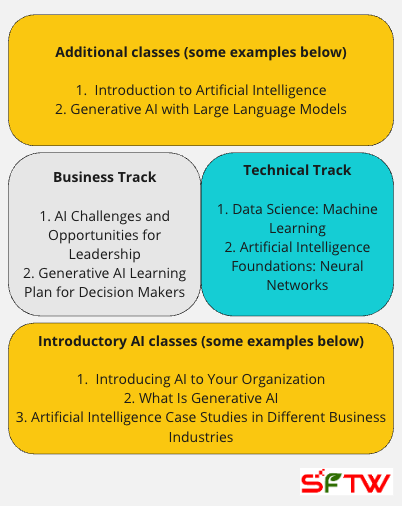
They chose a combination of free and paid online classes, suitable for their teams. I appreciated their approach of tailoring the training tracks based on your role - business or technical, and created four tracks as shown below. I like this framework to create a shared understanding among all the AI ambassadors, with an ability to tailor it based on your job function, expertise, and interests.
It is all well and good to be trained on the latest technology like artificial intelligence, LLMs etc. But all these tools amount to diddly-squat, if you are not using them to solve real problems. The goal of any initiative should not to adopt a particular type of technology, but to solve tangible problems for your customers (internal or external) to create and capture incremental value.
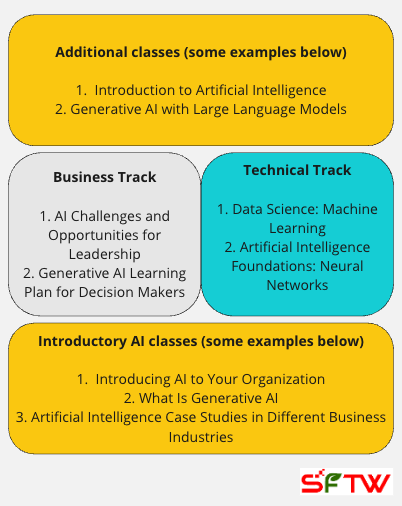
Four tracks with some representative examples of courses. Schematic by Rhishi Pethe
Creating customer value
To support this, each of Cultura’s participating companies was asked to come up with potential use cases based on some of the high priority problems faced by their customers, and their business. Each team used an agreed upon framework to evaluate and prioritize their use cases. As a product manager, who lives and dies by use cases and prioritization, this was the most fun part of the exercise for me!
Working with external experts, the portfolio teams went through a detailed analysis of each and every use case, prioritized them using certain Cultura specific rubrics, analyzed data needs, weighed them in the context of their overall roadmap, and evaluated the right tools to address those use cases.
This analysis identified some opportunities to make changes to existing workflows and systems, which would not only improve delivery of customer value, but also get those systems more ready for AI enabled workflows.
I always have fun in not thinking about use cases as some atomic feature to be delivered to your end customer, but to prioritize them in the context of your overall roadmap.
The Cultura leadership rightly provided guidance to start small, learn, iterate, and expand. I have often seen many projects fail (and I have made this mistake as well), due to lack of customer discovery, willingness-to-pay discussion, not doing a feasibility analysis, or trying to bite off a big part of your problem in one go.
Most of this analysis was done before all the AI ambassadors and external experts got together in person for a hands-on workshop to talk about each business learnings, and how they could collaborate together. The IRL meetings brought to life the challenges and opportunities each team faced, fostered open discussion, expanded the surface area for serendipity, and resulted in some cool cross-team collaborations. Truly the type of collaborative environment they are encouraging across our entire industry.
Sustainable processes
I have been in many meetings throughout my corporate career, where different teams come together once a year (or once every 6 months) to discuss some new direction or initiative. There is a lot of excitement, and engagement during the in-person meeting. Many interesting ideas and approaches are discussed, and planned for.
But once you go back to your desk (or home office for remote employees), you get busy with your day-to-day responsibilities, you get busy with your customer queries and budgeting exercises, and a million other things. One time I spent about a day-and-a-half in a large meeting to reformulate our prioritization framework. But nothing came of it, once we went back to our dens.
The excitement from the in-person meetings dissipates faster than for an Instagram reel by a social media influencer.
Aristotle had once famously said, “Well begun is half done!”, but it is only half done. Most initiatives fail here.
In my experience, unless you set up a sustainable process, and assign owners to continue the initiatives post the in-person (or concentrated time) workshop, the half life of these projects is as long as your flight back home. It is only when incentives of assigned owners are aligned with these initiatives can these projects move forward. This was one of the common fears expressed by many of the businesses towards the end of the workshop.
If these initiatives are treated as side projects, they will fall to the side. To address this issue, Cultura did design a process for regular check-ins, knowledge sharing and learning sessions, and have teams hold themselves accountable towards the progress of their initiatives. An ongoing example of their company values to collaborate, empower, and commitment to help their businesses grow.
Key learnings and takeaways
If you are an organization starting out on a big initiative like digital transformation, or exploration of AI capabilities and its applicability to your business, here are some key takeaways to think about and consider for the overall success of your initiatives.
Garner leadership support & be deliberate with your approach.
Bring your customers along on the journey
Arm your teams with the right information, training, and resources, including external help as necessary.
Have a hypothesis on your direction and draw throughlines to your long term strategy
Engineer diverse, cross-functional interactions to spur innovation and idea generation, especially from teams closest to your customers
Don’t chase the shiny object, don’t fall for FOMO, don’t keep your head in the sand
Choose the right tool for the right problem - don’t go looking for nails for your AI hammer
Experiment, experiment, experiment, prioritize, prioritize, prioritize
Learn from other industries, and other teams - collaborate and work in circles, not rows
Design systems for self-sustaining processes, and hold teams accountable
Design leading indicators rather than lagging indicators to measure progress
Design your user experiences so humans can trust the AI output to improve rate of adoption.
AI is the right tool to engage with for many of your customer’s problems.
The right time to engage with AI is now.
If you want to know more about how your organization can get started on or accelerate their digital transformation journey within agrifood space, please reach out to me, or schedule some time on my calendar.