


Programming Note: I will be hosting my first Substack Live with Food Futurist, and Innovation Strategist, Mike Lee on June 26th, and with Preethy Iyer on June 29, who is building Kai Thota in India and is empowering women farmers.
I am excited to restart the SFTW Convo series with the first conversation of 2026.
SVG Ventures | THRIVE is a Venture & Innovation Platform advancing the Food and Agriculture industries.
They work with leading corporations, startups, universities, and growers to solve the biggest challenges facing the food and agriculture sector.
SVG|THRIVE has worked with more than 15,000 startups across more than 100 countries.
Just before World Agritech 2026, I had the opportunity to sit down with John Hartnett, CEO and Founder of SVG|THRIVE, and Marion Meyer, Managing Director of Corporate Innovation, to discuss the state of innovation in the agrifood ecosystem.
Our conversation touched on the history and philosophy of SVG|THRIVE, the nature of innovation, how corporates can access outside innovation by working with startups, and the challenges and opportunities in that process, the big trends in agrifood as seen by SVG|THRIVE how the ecosystem is thinking about the adoption of AI, how corporates are ready (or not ready) for AI, and how SVG|THRIVE is reformulating its approach with a change in the pace of innovation.
We talked about whether agrifood is like a Bermuda Triangle, how an ecosystem model is like Tinder, and how international understanding and connections are critical for SVG|THRIVE.
I hope you enjoy this conversation as much as I did having it.
History of SVG Ventures|THRIVE
Rhishi Pethe: John, you founded SVG Ventures. What are some of the core principles that you follow? Initially, you said, “I want to connect Silicon Valley to Salinas Valley”. It’s 2026. Could you speak to your mission and how things are going?
John Hartnett: I’ve been in Silicon Valley for almost 30 years. I’ve had a front-row seat to companies like Google walking in as startups and watching them scale. I spent a decade building a smartphone company and interacting with the network here, the VCs, the corporates, the startups. Much of what became THRIVE came from that experience and what I see as the recipe for success.
When we founded THRIVE, we didn’t want to build a traditional fund that simply invests and takes board seats. We recognized that successful companies need more support in scaling, access to customers, capital, international markets, and the right talent and experience. Our goal was to build a platform that could deliver all of that.
Of course, the tip of the spear is investment. That’s our main pillar. Ultimately, everything we do leads to investment outcomes, and today we’re investing through two funds: our Pioneer Fund and our Sunrise Fund.
Our second pillar is venture development. We help startups grow at scale through programs that meet them at different stages, from our venture studio at the earliest phase to our academy and through to our flagship accelerator. We work with startups from idea to Series A. Entrepreneurs learn best from other entrepreneurs. It’s not about lectures or theory. It’s about lived experience and navigating the journey firsthand. Our venture development platform is built around that principle.
The third pillar is the ecosystem and network. It’s connecting key people who will be influential in the scaling and success of companies, including board members, customers, investors, growers, and farmers. We’ve found this to be particularly critical in the food supply chain. It’s one of the oldest industries in the world, yet it remains highly fragmented and difficult to navigate.
One of the things we joked about when we were looking at how to connect the dots between Salinas and Silicon Valley was that entrepreneurs and farmers aren’t hanging out in San Francisco, drinking cappuccinos together. They operate in very different worlds, so the question becomes, how do you connect them? In the Bay Area, the power of networks is evident: look at the founders of Google, the connections at Kleiner Perkins with John Doerr, the connections with Bill Campbell and Eric Schmidt, and the relationships among all the players there. People call it an ecosystem; you can call it a network. We use both. It’s about connecting key people who will be influential in the scaling and success of companies. That’s a network in action. We wanted to create one for food and ag.
Our fourth pillar is engaging with corporates. In food and ag, significant exits tend to be trade sales, rather than IPOs, making corporates crucial, whether as customers or strategic investors. The most forward-thinking corporates recognize that innovation doesn’t just happen within their own walls. They actively look outside for disruption and new ideas. That includes start-ups, as well as industry peer connections within or beyond their own sector.
Those four pillars are what hold up our platform.
I live in Silicon Valley, an hour from fields, farmers, and some of the biggest players in specialty crops, but we still weren’t connected. And at the time, the food industry continues to face challenges, whether known or not, related to water, labor, climate adaptation, and climate change.
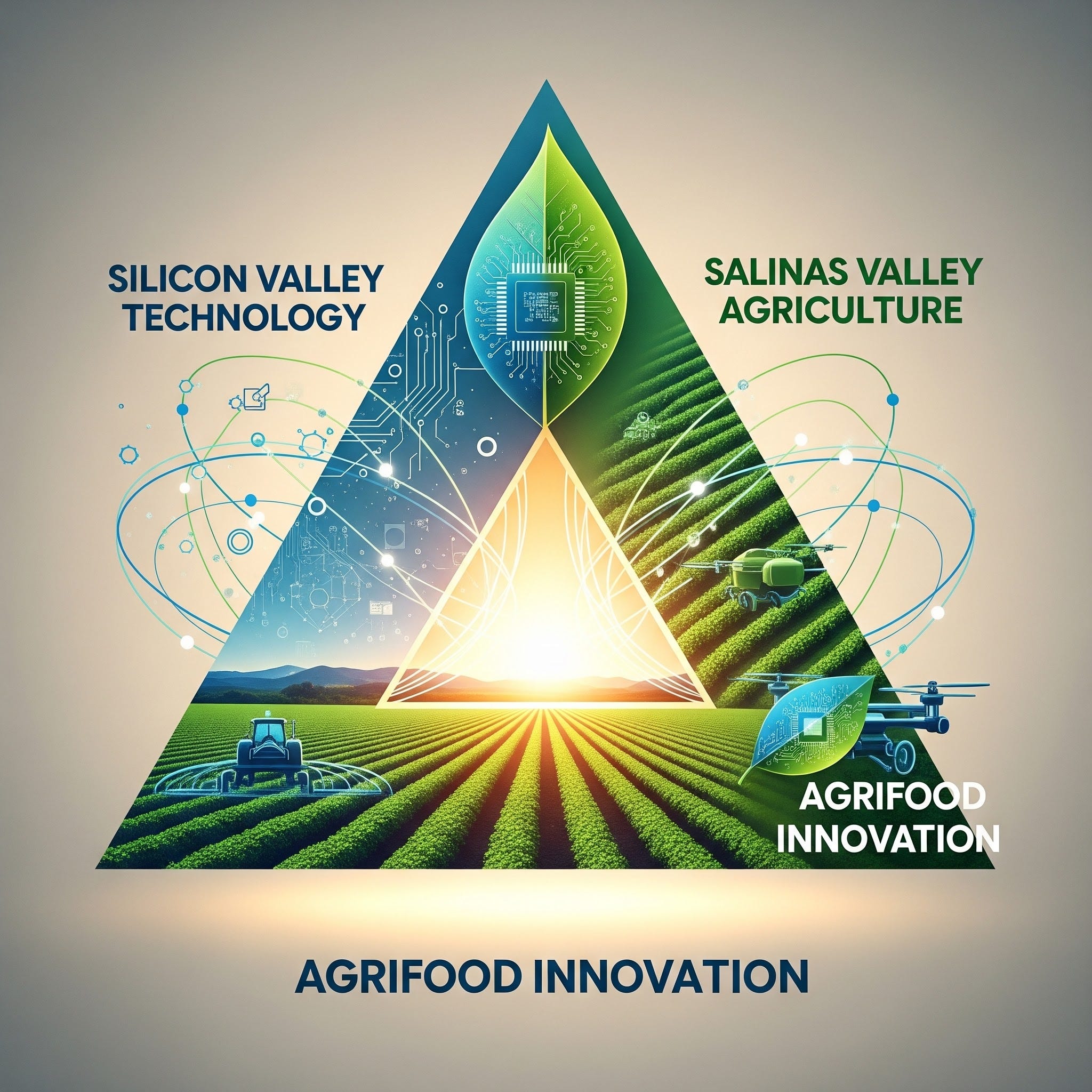
So I spent time early on with Bruce Taylor, chairman and founder of Taylor Farms, and Dennis Donohue, then mayor of Salinas, and we looked at how to bridge the gap. And we really took the approach of calling this where we are, like the Golden Triangle: Silicon Valley technology and investment to the west; the capital of fresh food and wine to the south and north; UC Davis, one of the world’s top agricultural universities, to the east. That’s where we wanted to bring it all together. And the formula we developed to address it is those four key areas: startups, ecosystem, corporations, and investment.
Ecosystem dynamics
Rhishi Pethe: You mentioned the ecosystem, innovation, how startups learn from others, and how entrepreneurs learn from other entrepreneurs. You mentioned the golden triangle. Right now, AgTech feels more like the Bermuda Triangle than the Golden Triangle.
Marion, you worked at corporates. You are physically thousands of miles away from Silicon Valley in Germany. When you think about ecosystems and innovation, could you characterize what you consider good innovation? What are some of the friction points that you see between startups and corporates?
Marion Meyer: Good innovation always starts with the same questions: What are you trying to achieve with innovation, and what are you solving for your customers? What does success look like?
Corporates have ongoing operations to sustain, but they also need to drive into the future. Those who have managed both areas have lasted for decades. But the speed of innovation has changed dramatically. What took 20 to 30 years in the last century now happens in three to five years or faster. So one of the most important things a corporation can do is ask: what are the topics that – even if they seem far away from core – could have an influential impact on our operations and value proposition? Where is the threat, and where is the opportunity?
Historically, a lot of innovation happened inside corporations, inventing new products and processes by their own teams –and that was sufficient. Today, a lot of great innovation is also coming from entrepreneurs building something new outside established companies and working across multiple technologies, which often aren’t part of the corporation’s DNA. The question becomes: how do we identify what is strategically relevant, gain access to it, and engage in ways that meaningfully impact the business?
For startups, the challenge is similar. They might have a great idea, passion, and the right moat to develop it and bring it to the market – but one can very rarely solve all challenges and access all growth steps alone. They could benefit enormously from other players, such as corporates, for deep market knowledge, existing infrastructure, and decades of customer access. But they often don’t know which door to knock on, or who to talk to.
Getting your own agenda clear, as a startup, a corporate, or an investor, is a prerequisite. And having someone who can enable and facilitate the collaboration, who understands both perspectives and can spot where the fit is, is invaluable.
Let me give an example. In one of my former companies, we experienced great excitement in the team about innovation and new technology. But often, innovators landed at various points of contact within the company, and employers were interested but had no real mandate (nor the time or process) to act on them. They’d do nothing, reject engagement, or pass it along inside the company, say “this is interesting,” and nothing would happen. We then launched an open innovation initiative and made ourselves visible and accessible to the outside world. Suddenly, startups had a real door to knock on. It is not just an email address, but someone who would look at it and respond. And we had a funnel and process created to ensure we were seeing, filtering, and reviewing the interesting ones for us. What is crucial for success is identifying the topics and partners you really want to engage with. Finding the path from idea to objective to action is everything.
Corporates, Corporate Venture, and Innovation
Rhishi Pethe: John, when you talked about access, it’s not just access to corporates for startups, it’s access to startups for a big company. Marion, you’re seeing the pace of innovation accelerate. John, how are corporates actually keeping an eye on what’s happening within the ecosystem, which startups are working on what, and what are the trends? Setting up a corporate venture capital fund was one mechanism. But we are seeing a pullback. FMC shut down its corporate venture fund. Other corporate venture funds have not made many investments. Do you see that their current approach is reasonable?
John Hartnett: Venture capital has been one of the first avenues many corporates have explored, often through setting up their own CVC. They gain tremendous insights by doing this, but alternatively, they can invest in independent VC funds.
The CVC Avenue is expensive and risky because corporates aren’t just looking for financial returns. They are seeking strategic value, including deeper market understanding, early visibility into disruptions and emerging trends, key areas to address proactively, and potential acquisition opportunities. They also want access to information, to the hottest startups, and financial upside.
Finding the right startup is like finding a needle in a haystack.
Corporates often don’t have the luxury to dig through that haystack. That’s why they’re leaning into organizations like ours. Over the past decade, we’ve built a network of 15,000 startups across more than 100 countries. That didn’t happen overnight. But we’ve also built an intelligence layer on top of it. We don’t just know who these companies are; we’ve engaged with them. We’ve accelerated over 300 of them. When you evaluate a company, technology is essential, but you’re also looking at the team, the traction, the problem they’re solving. And not every corporate partner wants to invest or acquire. Driscoll’s, for instance, isn’t looking to buy companies. Instead, they want to solve real-world problems around water, irrigation, and labor.
Rhishi Pethe: So you are doing matchmaking between corporates and startups. It’s like Tinder for innovation, I guess?
John Hartnett: If we take the Tinder analogy, before you get married, you date, you get engaged, then you commit. Nobody gets married on day one. Our accelerator programs de-risk the engagement cycle. We’re working with these startups for months, sometimes years. You get to “date” the people and the companies for a time before committing to anything.
Rhishi Pethe: You guys mentioned that you help corporate executives identify which startups to engage with, depending on their needs, thanks to your strong network. If you flip the question, not every startup can work with every corporate client. What is the process for saying, “You should work with these one or two corporates because they’re a better fit for the startup”? How does the reverse matchmaking work?
Marion Meyer: The better we know a startup, the better we can judge whether there’s a genuine fit with a particular corporate, because they are solving or supporting exactly what this corporate needs or is looking for.
We start by getting to know the startup deeply, what they’re doing, and how it fits a real market need on the customer’s or corporate side. We have different programs depending on the stage of the start-up, which allow us to do this, especially our accelerator, challenges, and immersion programs. We also recently launched a Scale-Up Assessment. It is a structured deep dive that examines a startup’s setup, organization, solution, and go-to-market strategy and identifies gaps, risks, and opportunities for the next phase of growth. And enablers and potential partners for commercialization and growth, such as Corporates.
On the other side, we spend a significant amount of time with each corporate partner to understand their strategic priorities and innovation needs. We listen carefully but also offer an outside-in perspective. For corporates who are still early in their innovation journey or want to review their existing activities, we offer an innovation assessment to help build the process, set priorities, and sharpen scouting areas.
For more advanced organizations, we execute through structured briefings and ongoing reviews to ensure continuity across innovation pathways while allowing for flexibility and adaptation.
Sometimes a fit between start-up and Corporate might be seen via a pre-identified scouting area; sometimes a fit appears as an unforeseen solution, for instance, when it hasn’t been on the radar of a particular technology search. Still, it provides a desired solution from an unexpected track.
Trendspotting
Rhishi Pethe: John, you have worked with 15,000 startups over the last 10-15 years and have talked with many corporates. Your team will have a front-row seat to current trends and what these amazing entrepreneurs and corporates are thinking.
What are some of the two or three trends that everybody is always curious about? Here in San Francisco, if you don’t mention AI, people think you are a psychopath.
Could you speak to the broader macro trends in the sector and then explain how AI fits into them?
John Hartnett: Technology follows big problems. That’s why we remain passionate and excited about food, agriculture, and climate. The big problems out there today will unlock the big technology solutions.
On one side, you have resource scarcity, arable land, water, energy, and labor, which significantly affect production. At the same time, we’re seeing the cumulative effects of fires, droughts, and extreme weather on production. We’ve also seen our supply chains be very fragile. We went through COVID, showing us how quickly empty shelves can appear. We’ve seen the effects of geopolitical conflicts, which have increased food costs significantly in many areas. On the other side, health and nutrition have become central to how people think about what they eat. Yet the US still has some of the highest obesity rates in the world. These are the big challenges to tackle.
For us, breaking it down into actionable innovation themes means looking at it from a deep-tech perspective.
The first major trend we’re watching is the intersection of biology and AI. Companies like Heritable, a spin-out from Google, are working on programming plants to address resource scarcity, reduce climate effects, and deliver more nutritious food. That deep-tech intersection feels like one of the biggest opportunities of our lifetime.
The second big thing is physical AI. AI applied to robotics and automation. Physical AI will unlock solutions to real-world agricultural challenges much faster than many expect. And it will attract major tech players to this space in ways we haven’t seen yet. Software eats the world, right? But when that software evolves beyond digital confines and enters the physical world, it will be eating faster.
Then, I think this is always up for debate, and I’m still in the camp that CEA farming is going to get to the other side of the bridge here. I know the timing hasn’t been right. The economics of running large-scale facilities haven’t been penciled out yet. But I keep coming back to smartphones. Everyone thinks that the story started in 2007 with the iPhone. It started a decade earlier. The timing and technology just weren’t aligned. You needed compute power that fit in your hand, and networks fast enough to support it. None of that happened overnight. Apply that same lens to where we are with agrifood and AI, and I think the timing is now to support it.
Big tech’s engagement in AI applied to life sciences, agrifood, and climate has been tentative so far. Google’s Mineral was a compelling experiment, but it didn’t represent a full commitment to the sector. Microsoft has dipped a toe in, but none of the major AI players, such as NVIDIA and AMD, have truly engaged. I think that changes with physical AI, and when it does, you’ll see these sectors light up in a significant way in a two-to-five-year window. The more big tech gets into this sector, the bigger the opportunity, the faster it’s going to happen.
There’s been a lot of hype in AgriFoodTech, but that hasn’t always translated into strong outcomes. We saw a similar dynamic during the early internet era: from 1998 to 2001, all you needed was “dotcom” in your name for valuations to skyrocket. But out of that came Google and Yahoo. I joke a little bit that after COVID hit in 2022, investors acted like drunken sailors, investing from home because they thought agrifood was a hot area, but they didn’t fully understand it. Yet I do believe that out of the current hype cycle will come some of the biggest companies in agrifood. And those companies that come out the other side will be the ones built to last.
Corporate Innovation
Rhishi Pethe: It’s a good parallel you drew to the internet or the smartphone. We’ll see much more movement and development in this area over the next 2-5 years, especially in AI. If I’m a corporate, I need to be ready to take advantage of it. Marion, when you talk to different corporates, how much of the amazing innovation coming through AI are they able to take advantage of? And how ready do you think they are when some of the things that John is talking about will start to pick up the pace even more? And if they’re not ready, what are the gaps? How do you help them figure that out?
Marion Meyer: Every corporate I speak to is experimenting, and that’s exactly right. But it’s important to understand that “AI” isn’t one single topic for a corporation. It operates across multiple layers, and you have to manage them deliberately.
The first layer is AI for organization and process, tools that apply broadly, regardless of sector, to how you work internally. This is where adoption is the hardest challenge. AI isn’t a typical system rollout. You don’t implement a tool and tick the box. You have to change behavior, culture, and processes, and the way people think about and use these tools. The journey has started, but it’s far from over.
The second layer is AI applied to differentiating processes. Your R&D, your time-to-market, your cost of production. These have real competitive implications. And the third layer is AI in the products and services you build for customers.
There’s still a meaningful opportunity, particularly in internal R&D and operational functions that aren’t traditionally IT-focused. Most organizations are still in the early stages of mapping out what AI can and should actually do for those teams. Two practical things can help. First, set priorities rather than trying to do everything at once. Identify the core layers, make tool choices, and bring your teams along properly. Second, be deliberate about data. Know what’s proprietary, what you’re willing to share, and in what context. If you try to protect everything, you limit your ability to use the most powerful tools. If you carelessly give away your proprietary data, you may put an asset at risk or create a dependency. Getting that clarity is foundational.
We support Corporates and Start-ups also in the arena of AI-driven innovation. One element is curated networking for our partners – in dedicated roundtables, we bring industry players together to exchange insights on initiatives, challenges, and best practices, as well as perspectives on the most impactful developments. We add external speakers to provide insights and inspiration, and we bring the tech industry into that conversation. In 2025, we initiated an AI & Automation roundtable, and we will have the next one alongside the Global Impact Summit 2026. In addition, we are launching complementary AI-focused innovation services. With those services, we can help companies find and understand the right starting point, put curiosity to use in use cases, and drive value.
EU vs. the US
Rhishi Pethe: Because you’re from Europe, I have to ask you this question. Sitting here in Silicon Valley, some people look down on Europe for its regulation and how it deals with innovation.
Does that question come up in your conversations with corporates or startups? You’re in Germany, you shut down a bunch of nuclear plants, and people criticize it over here. What can the US, or US ag tech or agri-food tech, learn from the European approach to innovation? What are your inputs on that when it comes to SVG|THRIVE?
Marion Meyer: First of all, many ideas, challenges, and approaches around innovation we talked about are shared within corporates and start-ups, independent from the individual markets and regions they are operating in. Most companies already operate globally or plan to do so. That’s why support is not limited to regional experience but could also benefit from additional lenses and insights into other markets.
We do see specific regulation and sustainability requirements in Europe. They do slow down innovation in some respects. There’s no doubt about that. But they can also be a trigger for it. When a regulation effectively says “you can’t do this anymore,” it creates real pressure to find an alternative. Business finds a way, like water finding its path. Frankly, that kind of pressure often drives more durable innovation than subsidies do.
The second thing Europe offers is deep industrial and engineering competence. When we talk about physical AI and automation, Europe and Germany in particular have decades of robotics and manufacturing expertise embedded in both corporations and universities. When that hardware and process knowledge combine with software capabilities, much of which comes from the US, the results can be very powerful. We’re already seeing that with unmanned aviation and geospatial data. In the Munich ecosystem, for example, we are seeing a wave of drone and related technology startups driven by dual-use applications, and the underlying knowledge transfer may directly benefit agriculture.
Third, Europe’s diversity can actually be seen as an asset. Europe is facing pricing challenges as dozens of distinct markets operate within a shared economic framework. A company that learns to scale across Europe has learned something genuinely hard. That capability translates globally.
Silicon Valley is SVG’s headquarters, but it’s a global team, and team members are also deeply embedded in the Canadian market, in Ireland, across Europe. We’re connected to ecosystems around the world, which enables us to understand different markets, bridge regions, and match technology to local use cases.
John Hartnett: Global reach is a non-negotiable for us. Seventy percent of the 15,000 startups we engage with are outside the US. We’ve taken what we call the A7 approach, focusing on the seven most important agrifood markets globally.
Evolution of the SVG Model
Rhishi Pethe: John. You’ve been in this space for more than 10 years. People talk about how one-person teams or two-person teams can scale ARR very quickly. Do some of those principles apply to the sector that you’re working in? If yes, how do you see the SVG|THRIVE model evolving over the next five years?
John Hartnett: The model is already evolving. When we started, we were very focused upstream. As we’ve looked at where technology has the greatest impact across the food system, the frame has expanded. It’s now genuinely farm-to-fork. We’ve broadened our focus over the past few years to reflect that, and now we include downstream, supply chain, and delivery technologies.
We’ve also leaned much more heavily into climate and sustainability. We launched our Global Impact Initiative in 2020, specifically to help corporates deliver on the ambitious 2030 and 2050 sustainability targets they’ve committed to. That’s a growing part of our work.
Another key area is deep tech, given its ability to address challenges across ag, food, life sciences, supply chain, and related areas. It’s largely sector-agnostic. Something that solves a problem in the food supply chain may also solve a problem in construction or another industry. We’re continuing to refine our investment thesis, putting deep tech in focus as a solution for planetary health, human health, and supply chain resilience.
In parallel, our focus is to scale our investment platform. To date, we’ve primarily invested at the Seed and Series A stages, deploying approximately $100 million. We see a significant opportunity to expand this further. The market opportunity clearly supports it.
Rhishi Pethe: Thank you, John and Marion, for your time today and your work for making it easier to bring innovations to market at scale.
This was very interesting Rhishi, thanks for posting.