

Only farming gets the “subsistence” label
AI alone won't drag us out of it

Currently, for one of my projects, I work as a Senior AI advisor for the Gates Foundation for AI advisory services in South Asia and Africa. I have authored multiple white papers on AI in Agriculture, and recently appeared on a podcast on AI in Indian Agriculture with Venky Ramachandran.
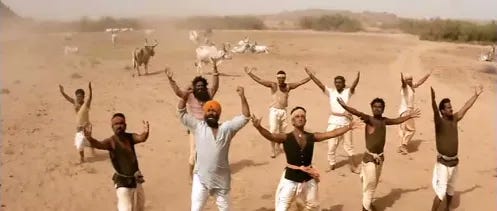
The Bollywood movie “Lagaan” (Land Tax)1, set in the 1890s, tells the story of how the population of a small farming village in India is driven into bankruptcy and ruin when rainfall fails, and a drought sets in. The local colonial British tax authorities do not provide any relief. The villagers either pay the tax or find another way out.
Some things about this situation have not changed in 2026.
Even though the Britishers are long gone, and the government does not impose direct punishing taxes on Indian farmers, millions of farmers in India are at the mercy of rainfall. They are a season or two away from being pushed into extremely challenging economic situations.
Let us take the example of a farmer in a village in India. He farms seven-tenths of a hectare (the average farm size in India, smaller than a soccer field). The monsoon (rainy season) has been irregular, and he has had to make tough decisions about which crop to plant as input prices, such as fertilizer, have shot up over the last few years.
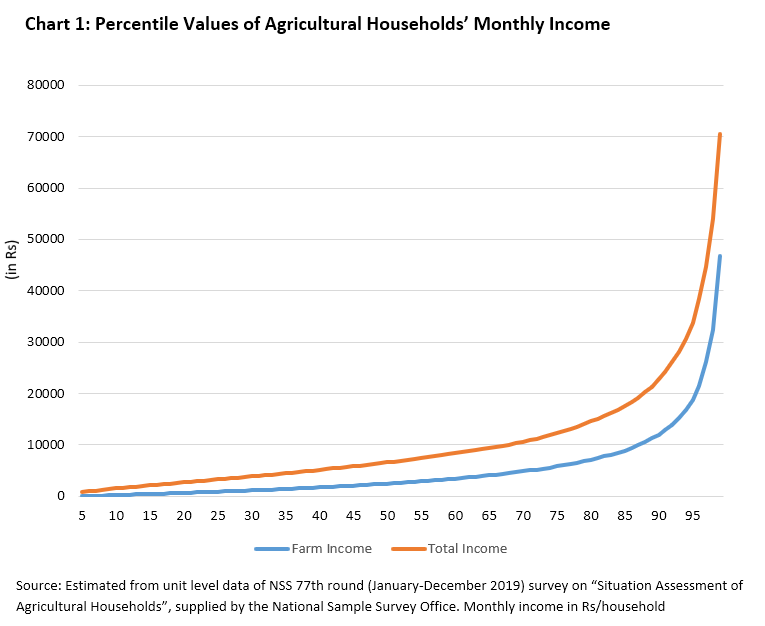
He has inherited this piece of land, which was twice the size, when his grandfather farmed. This farmer’s average monthly income is about ₹5,300.
That is roughly fifty-five dollars.
He can barely feed his family and relies on off-farm work to augment his income, which is often extremely difficult to find. He is one of nearly 700 million people in India who live off the land, and his life is the statistical center of Indian agriculture.
There is a word for this type of farming. It is called “subsistence” farming.
It is a strange way to define a profession.
We don’t say “subsistence plumbing,” or “subsistence manufacturing,” or “subsistence consulting.”
The use of the word “subsistence” is a quiet admission that hundreds of millions of people in South Asia and Africa produce food that is barely enough to stay alive to do it again tomorrow. And unfortunately, they are trapped in this situation2.
And AI alone will not help extract them from the situation.
The idea of putting an AI agronomist and an AI advisor in the pocket of every smallholder, which helps with on-farm management decisions and access to important information about resources and markets, is one of the most promising developments in the sector.
The AI-powered capability is real, and some of the early gains seen by organizations like Digital Green, KissanAI, and others are real. For example, even with the video intervention from Digital Green3,
Researchers found that the video increased farmers’ agricultural productivity and profits. After one year, farmers who were offered the videos increased yields by 12-18 percent and estimated profits by 9-24 percent, relative to farmers who received conventional extension, with smaller effects after two years.
An AI-powered agronomist (when farmers have very limited access to this kind of expertise in a place like India) can help lift farmers’ income, reduce their risks, and keep their children in school longer, at one-tenth the cost of previous video-based interventions.
Unfortunately, it does not solve some of the other structural problems that plague Indian agriculture.
And given India’s agricultural workforce size, it is a huge problem!
The scale of the problem
In a huge country like India, with a population of 1.5 billion, 43% of the working population is engaged in farming!
As Shruti Rajagopalan et al said in their 2024 paper4,
Indians make up roughly 17% of the world’s population, living on only 2.5% of the global landmass, representing one of the lowest levels of land area per capita worldwide. Agriculture’s share of GDP has fallen to roughly 16% for FY 2024, yet it employs nearly half the workforce. This suggests profound spatial and economic misallocation. Workers remain trapped in low-productivity rural areas because land markets function poorly. Fragmented holdings, unclear titles, and restrictions on land sales keep agricultural land locked in place.
There are a few countries, such as the United States and the Netherlands, that have pushed the frontier on this metric more than most. In the United States and the Netherlands, about 1-3% of the population is involved in agriculture, and agriculture contributes roughly the same percentage to each country’s GDP.
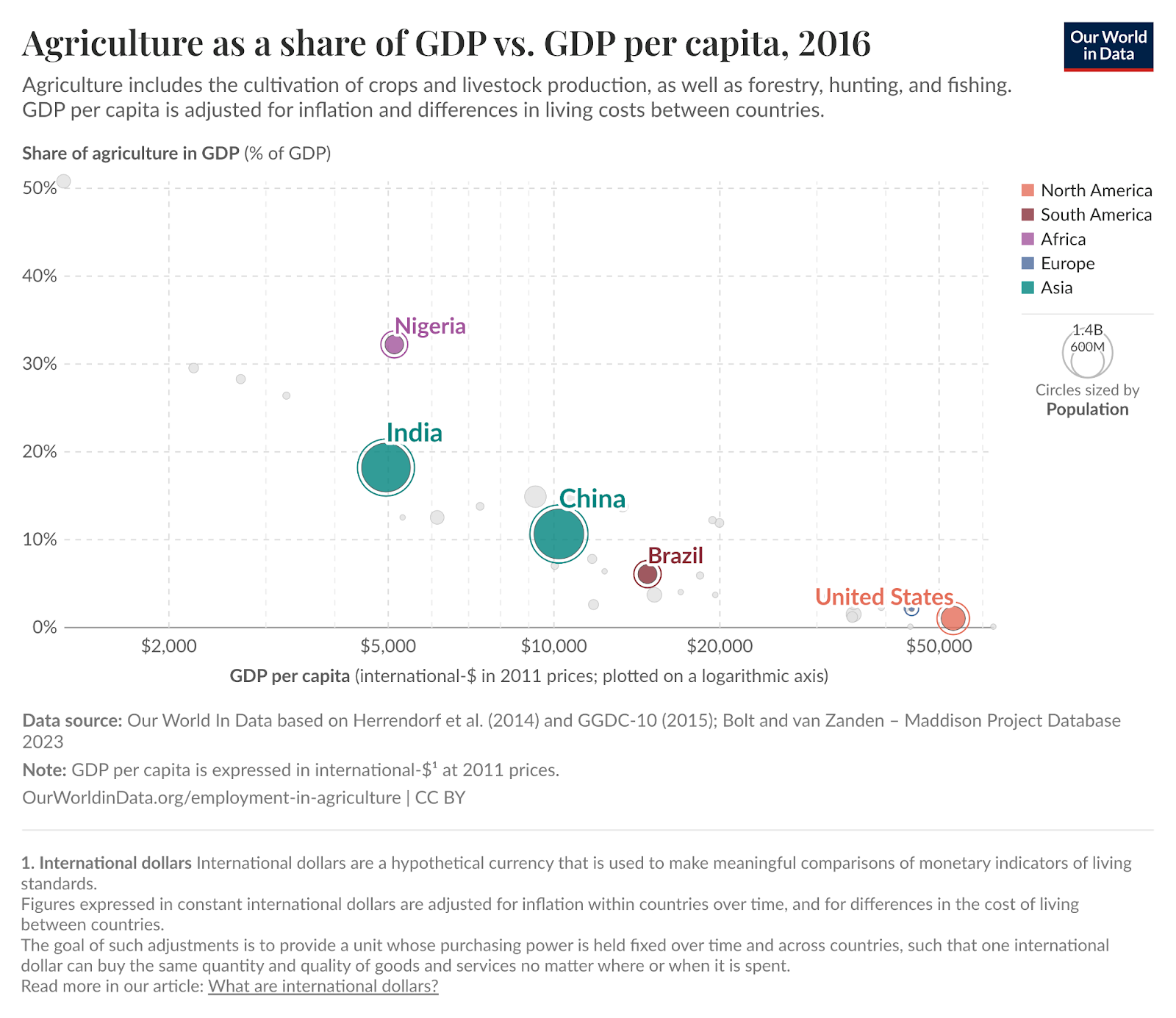
If you look at these numbers and the tough life of farmers, it feels like we should have fewer people involved with farming in Asia and Africa. The life of a farmer is tough for most of the hundreds of millions of farmers, especially in the Global South. They work long hours, are at the mercy of the market, and with small plots, can barely feed their families.
For example, the reality of most Indian farmers is not romantic. Nearly 400,000 farmers took their own lives in India between 1995 and 2018 (48 farmer suicides per day). The suicide rate among Indian farmers is now 47% higher than the national average.
Crushing indebtedness (not GMOs) is one of the leading causes of stress, stemming from insufficient agricultural investment and reliance on non-institutional credit sources. In India, even though the share of the working population engaged in farming has declined over the last few decades, the mismatch between its contribution to GDP and its share has widened.
Sood (2018) reported that 76% of farmers wanted to give up farming. Agriculture is seen as a non-remunerative livelihood activity with unstable returns due to rising production costs, climate risks, market failures, and a lack of social respectability.
India is an also outlier in terms of average farm size. In almost all countries (except India), less efficient farmers (or farmers who wanted to exit farming) either leased or sold their land to move to urban centers, thereby driving land consolidation.
The average size of operational holdings decreased from 2.28 hectares in 1970-71 to 1.84 hectares in 1980-81, to 1.41 hectares in 1995-96, and to 1.08 hectares in 2015-16. Average landholding size decreased further from 1.08 hectares in 2016-17 to just 0.74 hectares in 2021-22.
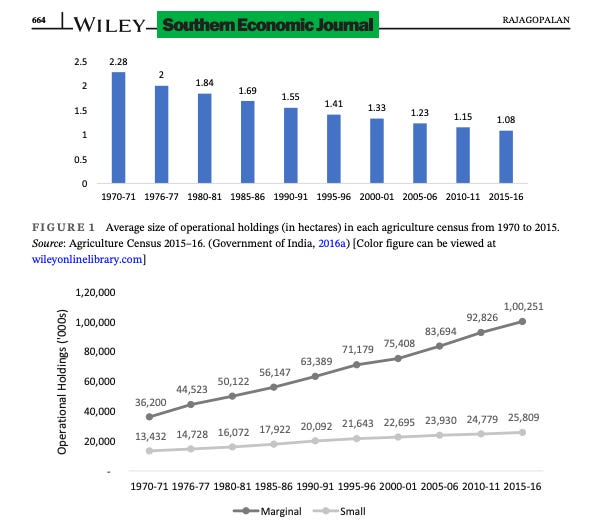
Very small landholdings make the application and adoption of any new technology extremely challenging. Any individual farmer has limited financial resources or cash flow to invest in farm improvements.
When you live in the SF Bay Area, you start to believe AI will solve all the problems in the world.
AI is a powerful force slated to transform many sectors in the coming years, but I believe AI alone will not solve India’s farming problems.
What structural change is actually required
AI advisory is very good for individual farmers’ welfare, but struggles to address major structural issues such as land-market lock-in, the subsidy system, and the absence of a non-farm economy.
Locked Land Markets
The existing agricultural land markets in India are locked up. India needs to make land leasing for agriculture much easier and implement land ceiling reforms that limit how much land one can own, with limits varying by state.
For example, in the western state of Gujarat (where I grew up), you must be a farmer or have an agricultural status to buy agricultural land. According to the land ceiling laws, an individual or family cannot own more than 54 acres of dry cropland. The land ceiling for perennially or seasonally irrigated land is from 10 to 27 acres!
Historically, land leasing in India has been heavily restricted and regulated by the state governments. In some states, there are strict prohibitions on leasing out agricultural land.
On the other end of the spectrum, some states do not prohibit leasing but strongly regulate it, and if a tenant works the land for a specified period, they acquire the right to purchase that land from the owner.
Some recent reforms pushed by the federal (central) government’s think tank have encouraged states to legalize and formalize land leasing.
Research has also shown that distortions arising from leasing and land ceiling regulations prevent land from flowing to the highest and most productive users5. The potential impact on agricultural productivity through efficient reallocation of land could be staggering!
An efficient reallocation of land in India increases agricultural productivity by 65 percent and by more than 100 percent in some states, with more than 50% of these effects attributed to state-level rental barriers. Distortions associated with land-market participation contribute substantially to agricultural productivity differences across Indian states.
A distorting subsidy system
India needs to reform the subsidy scheme, which addresses both the input side (fertilizer, power, irrigation, credit, crop insurance) and the output side through market price support. The subsidy schemes, especially on the input side, are a genuine safety net. But it creates significant structural challenges that trap farmers in a cycle of subsistence.
The massive amounts of money spent on the subsidy crowd out funding for other projects like irrigation, R&D, roads, and cold-chain infrastructure. For example, my friend Venky Ramachandran just pointed out in his latest newsletter edition the ridiculousness of the fertilizer subsidy for fiscal year 2027, and these numbers are from before the Strait of Hormuz fiasco!
India’s fertilizer subsidy for FY27 is budgeted at about ₹1.71 lakh crore6, more than the entire ₹1.33 lakh crore the Union Budget set aside for agriculture and farmers’ welfare that same year. The instrument built to support the farm sector now costs more than the ministry built to support it. How the hell did we get into this mess?
The subsidies have environmental damage baked into the incentives. As you just saw, the fertilizer subsidies for urea (nitrogen) are the largest, and the farmers over-apply nitrogen.
India’s N:P:K7 application ratio is roughly 7:2.7:1, compared with an ideal ratio of 4:2:1.
This leads to runoff and soil toxicity, which are harmful to soil health in the long run. The availability of free power to farmers creates an incentive for farmers to pump groundwater, which is costless. It has drained the aquifers in the rice- and wheat-growing regions in the north.
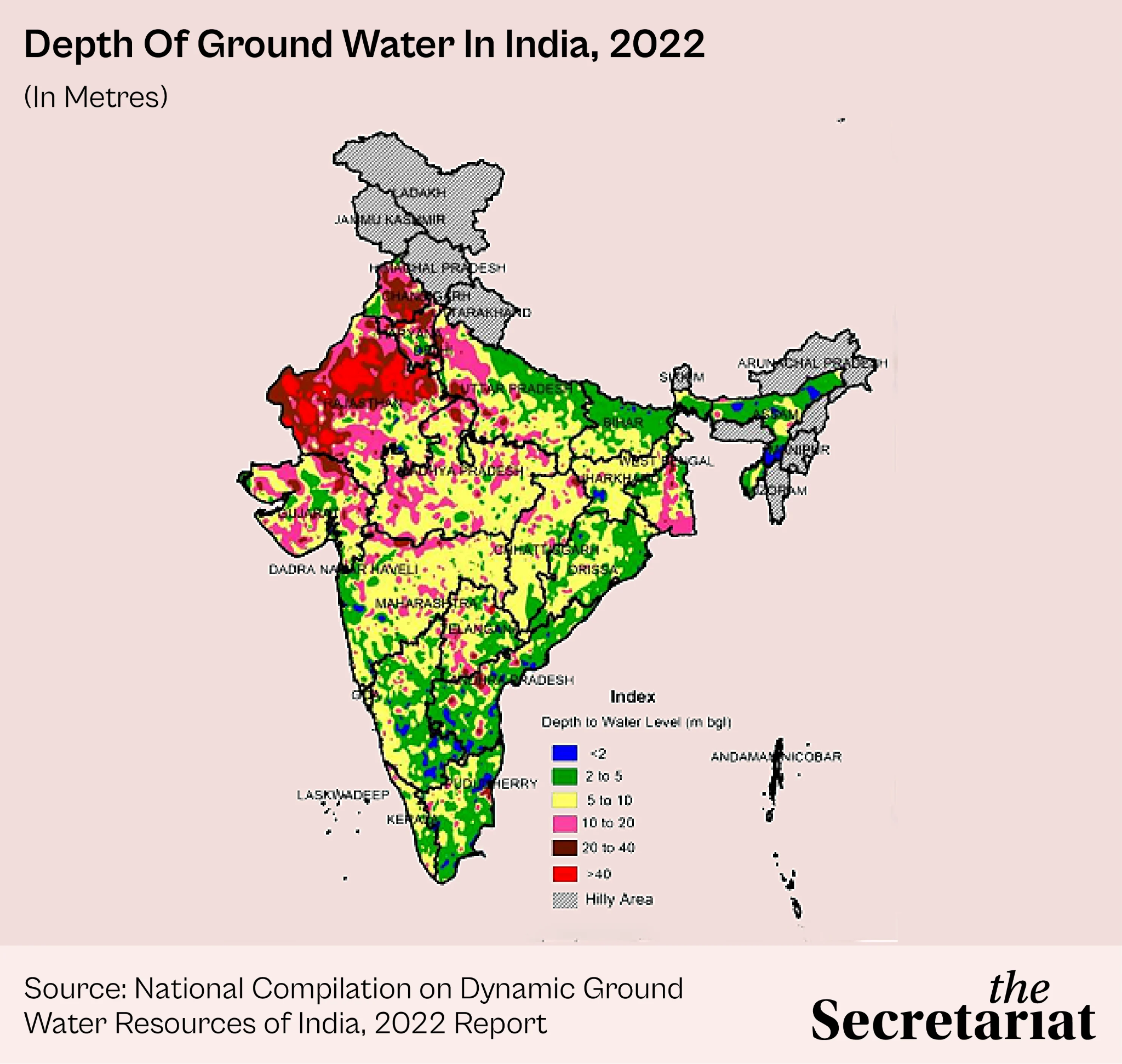
The excessive subsidies create a massive distortion in what gets grown. Price support through minimum-sales-price procurement focuses on rice and wheat. As a result, farmers continue to grow water-intensive crops in water-scarce regions instead of diversifying into pulses and oilseeds, which the country actually has to import.
It traps a large segment of the farming population in ever-shrinking plots, holds them hostage by input and output price volatility, keeps them entrenched in a cereal-heavy, groundwater-depleting status quo, and leaves them riding a subsidy tiger, with no way for the farmer to get off.
And the tiger is getting hungrier by the day.
Missing non-farm economy
The lack of creation of jobs outside farming through off-farm work, manufacturing capacity, and infrastructure investments does not provide exits for farmers who might want to get out.
Archaic land regulation makes both entry and exit difficult. But the reforms that could help are politically more or less frozen, as evidenced by the 20218 farming law battles. Many changes are occurring only at the margins, but many more structural reforms are needed.
The lack of substantive movement on the political front makes AI advisory attractive, as at least there is a clear path to individual farmer welfare with AI.
AI-driven services for knowledge access and dissemination
For farmers to be effective and efficient in growing crops, they often need help with when to plant, how to address specific crop threats, and product selection and timing. This is not a problem unique to any particular part of the world.
Africa and Asia also have systems of agricultural experts provided by their respective states (and private enterprises) to help farmers with their knowledge needs. Unfortunately, the ratio of farmers to agricultural experts in these regions can range from 3,000 to 1 to 10,000 to 1. Effectively, the farmers are farming without any expert help, other than what they can get from their neighbors and friends.
AI agronomists can deliver context-specific information to millions of farmers at a low cost. The cost of delivering these services is sometimes 100 times lower than that of existing non-tech methods. Data infrastructure and phone penetration are quite high in these countries, so there is an existing distribution infrastructure capable of delivering context-aware services to millions of farmers at very low cost.
Suppose you take a representative small farmer with 0.7 hectares, who grows rice and wheat in a semi-irrigated area. The national average monthly farm income is ₹5,300.
The AI advisory helps the farmer optimize timing, quantities, and products, resulting in a 25% increase in yield and a 20% reduction in costs. (World Economic Forum data9)
For a 0.7-hectare plot, with rice prices at ₹2,300/quintal (a quintal is 100 kg, or roughly 220 lbs), this translates into a monthly income increase of roughly ₹1,200-₹2,000.
This farmer goes from ₹5,300/month to perhaps ₹6,500-7,300/month. It will have a material impact on their condition as it might mean better food, children staying in school instead of getting pulled to work on the farm, or reduced borrowing from the informal money-lending economy.
But, they still earn far below the urban average. Without the savings to transition out of farming, they are still just one bad monsoon away from debt.
So, AI advisory has some meaningful impact, without structural change.
AI advisory improves individual farmers’ welfare. It does not help with the challenge of too many people on too little land producing poverty-level income on a 0.7-hectare plot. It does not help them escape the structural conditions of Indian agriculture, which include fragmented landholdings, a lack of non-farm jobs, frozen land markets, and inadequate social security.
The pathway to a structural change is indirect and generational. If AI-driven yield improvements give a family extra money to invest in a child’s secondary education or vocational training, then the child may be better positioned to exit. It is typically education that enables non-farm transition, not farm income.
One of the biggest economic threats to an Indian farmer is catastrophic variance. The reduction in risk from using AI advisory could be even more important than low average yields.
For the reality of Indian agriculture to change, the Indian economy needs to create non-farm jobs, build manufacturing capacity, and expand social security. It needs to reform its land tenancy laws around the land ceiling acts, and entry and exit requirements.
AI advisory services for Indian farmers are a valuable and scalable intervention. But it is important to keep in mind that they are a treatment for symptoms within a system that structurally produces those symptoms.
Technology helps farmers farm better, but only structural change can make farming populations smaller and more prosperous. India needs both, and one cannot substitute for the other.
Grants from institutions such as the Gates Foundation and the work of organizations such as Digital Green are funding an AI-powered advisory service to reach a growing share of farmers. There is real potential (and early evidence) for higher yields, lower risk, and for the AI advisory to nudge away from subsistence farming.
Conclusion
Food production (farming) is Lindy. As long as there are humans who must eat to survive and thrive, the profession will continue, though what it means can, will, and should change dramatically.
But at the same time, we need to move beyond the romanticism of farming (which is true for a percentage of people) and look at the reality of farming. We need to ask the question as to why we have and need so many farmers and what we can do to help them make a choice that is best for them, without being on the subsistence hamster wheel.
For a country like India, AI advisory services will have a meaningful impact, but for true structural change to happen, we will have to look at other vectors beyond and alongside AI. Given the lack of political progress, organizations need to continue developing AI services that can help millions of farmers increase their annual incomes and move further along the path to prosperity and out of subsistence farming.
The tax collector from the movie “Lagaan” is gone. But the Indian state has continued colonialism by finding subtler ways to tax the farmer. The village in Lagaan won by changing the rules of the game. Indian farmers also need a different set of rules for open land markets, rational subsidies, and an economy with somewhere to go.
It would be great to release hundreds of millions of people from the drudgery of farming and subsistence. AI will play a significant role in farmers’ individual welfare, but it will also need support from other structural reforms.
I want to thank Ariel Patton, Hiya Jain, Jannik Reigl, and Mike Riggs for their feedback on this piece. Any errors are purely my own.
“Software is Feeding the World” is a newsletter from “Metal Dog Labs.”
“Lagaan” is a land-tax or agriculture tax which farmers had to pay to their British colonial overlords in pre-independence India. Here is the Wikipedia entry for the Bollywood blockbuster movie “Lagaan”.
Shukla, V. (2025). A Short Note on Agricultural Household’s Farm Income: Evidence from the National Sample Survey 77th Round. The Indian Economic Journal. https://doi.org/10.1177/00194662241278072
Data from the report “Video-based support for small-scale farmers around the world”, July 2025, published by Abdul Latif Jameel Poverty Action Lab
Shruti Rajagopalan, Shreyas Narla, Ankita Dinkar, Kadambari Shah, and Ankit Bhatia. “Reforming Agricultural Land Conversion Laws in States.” Mercatus Research, Mercatus Center at George Mason University, Arlington, VA, 2026.
Misallocation in Indian Agriculture Marijn A. Bolhuis, Swapnika R. Rachapalli, and Diego Restuccia NBER Working Paper No. 29363 October 2021, Revised March 2025 JEL No. O11, O13, O4
Lakh = 100,000 and crore = 10 million.
NPK = Nitrogen Phosphorus Potassium are the 3 main nutrients in fertilizers
Indian Farming Laws, A grey-pill for Indian Agriculture, SFTW Convo with Venky Ramachandran, January 2021
“Farmers in India are using AI for agriculture – here’s how they could inspire the world” World Economic Forum, January 2024 (Jeremy Jurgens, Purushottam Kaushik)
This was a great read.
In my decades involved in agribusiness I have found that some of those who most passionately romanticize farming have never farmed a day of their life.
Thanks for linking to Venky Ramachandran’s piece, which I found very interesting and informative.
"Agriculture’s share of GDP has fallen to roughly 16% for FY 2024, yet it employs nearly half the workforce. This suggests profound spatial and economic misallocation." wow. I also had no idea there were actual caps on the number of acres a farmer could own, based on production.