

Scaling Innovation: EMILI
EMILI's innovation farms help with testing infrastructure

Scaling innovation is difficult. This monthly edition will highlight stories, strategies, and learnings on scaling innovation. We will highlight stories of startups, and the ecosystem which helps scale innovation.
One of my favorite economists, Alex Tabarrok wrote the following about the theory of innovation. (Highlights by me)
“Innovation is a dynamic process; success rarely comes on the first attempt. The key to innovation is continuous refinement and improvement. A firm with sales gains greater resources to invest in further research and development. Additionally, they benefit from customer feedback, which provides valuable insights for enhancing their products and processes. Learning by doing requires doing.”
This month’s edition features EMILI Innovation Farms. EMILI is a Canadian non-profit organization. EMILI helps startups learn by doing.
Have you seen claims for a selective spot spraying product which saves 90% chemicals? Have you seen claims for a new product which can increase your yields by 30%? These claims are often made by entrepreneurs based on the use of their product in a specific context, but the claim is made for all contexts.
It is as if an alien came to earth, saw Lebron play basketball, and told all their friends that all basketball players on earth are like Lebron, and they are screwed in the upcoming intergalactic basketball tournament!
Entrepreneurs often find it challenging to test their products in different contexts inherent to agriculture (soils, weather, management practices, crop types etc.).
EMILI Canada provides infrastructure to innovators to test their product for the Western Canada prairie context. When you are building a farm level product, it is important to have access to representative fields to help you test and iterate on your product or solution.
“EMILI (Enterprise Machine Intelligence Learning Initiative) is an industry-led non-profit committed to accelerating Canada’s growth as a leader in digital agriculture. We work with producers, industry, and academia to advance the adoption of intelligent technologies, and provide people with the skills required to succeed in a digital economy. EMILI is proudly based in Manitoba with projects that span the country.”
I had the privilege to connect with Jacqueline Keena (Managing Director, EMILI), Jennifer Cox (Manager of Communications, EMILI, and Greg Stewart (CEO of GECO Engineering, a startup working with EMILI) to understand EMILI’s approach.
Struggles with adoption & scale
Agtech companies have struggled with adoption over the last 10 years. Scaling innovation requires access to distribution, making your product work in different contexts inherent to agriculture, establishing proof points and evidence to show to your potential customers and delivering and capturing value. The lack of many large exits within AgTech in the last few years is living proof.
You have to define a problem and come up with solutions which solve the problem in a unique and differentiated way than the options available today. To get to this point, you need to be able to continuously test, get feedback, and get multiple reps to learn and iterate.
Context is important for on-farm products. Your solution should be able to work in different contexts of your customers and not only in the initial test conditions.
Some of the major challenges in the adoption of biological products has been due to the products not working as advertised because the context of use has been different than the context from which the claim was made.
Agricultural technology needs to work in localized settings with unique weather, soil and other differences. So what works in one region might not work in another.
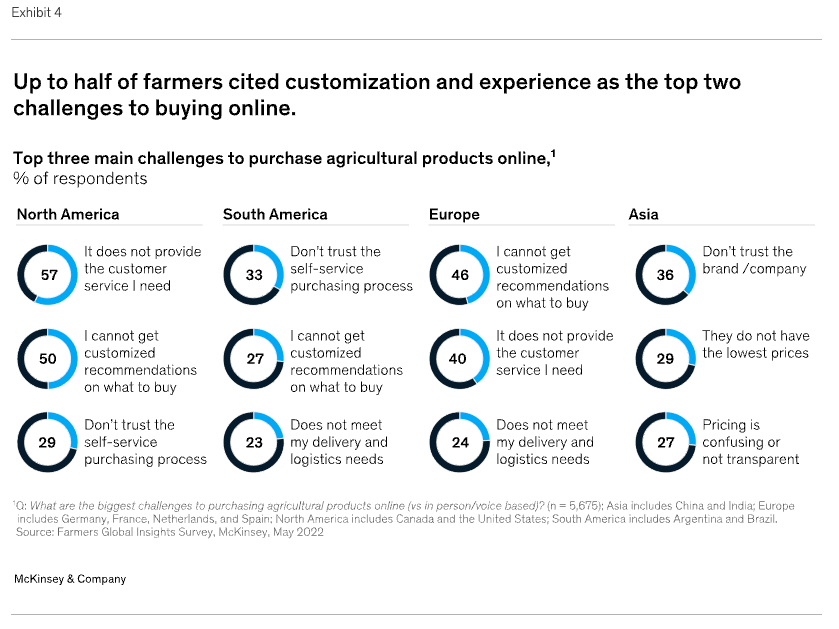
In previous editions of the SFTW, I have highlighted research on AgTech adoption from McKinsey which showed one of the main challenges to adoption is customization and personalization to the farmer’s context. (highlights by me)
“Agtech players now have the chance to further personalize products and business models, as well as offer more targeted solutions for small and medium farmers. By focusing on the uniqueness of each farmer’s operations, AgTech innovators can develop clear value propositions for their technologies, highlighting ROI with measurable KPIs.”
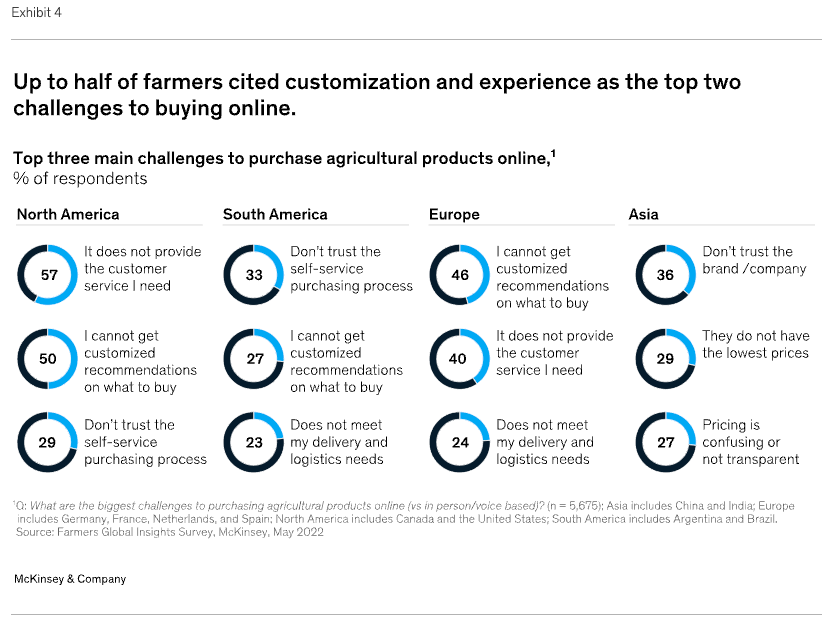
Image Source: AgTech adoption from McKinsey
Startups try to get access to innovative farmers, who are willing to test out a new (albeit) half-baked solution, and provide feedback to the entrepreneur. Entrepreneurs can try to work with larger companies with infrastructure to test their product.
When I was at The Climate Corp, we had access to Bayer’s large and diverse set of research and trial plots and a network of advanced growers who would be willing to work with a new product to help refine it. Entrepreneurs can work with their partners / customers to get access to their test plots. When I was Mineral, we often got data or had access to test plots for specialty crops from our customers.
Many entrepreneurs will work with a university to get access to research fields to help test their solution in real life conditions and under different circumstances. At Mineral, we had a partnership with a university in northern California. We could run different tests there for commodity row crop use cases.
The entrepreneur has to make sure they have access to testing infrastructure and position the product based on the context.
EMILI Innovation Farms
There are other models for testing AgTech products at the farm level.
One example is the Grand Farm facility in Fargo, North Dakota. Grand Farms provides infrastructure to help entrepreneurs test their solutions on a real farm, and connects them with growers who can come visit the farm and see some of the early stage technology in action and provide feedback.
EMILI is an industry-led non-profit with a strong focus on the public good. It works to grow a sustainable and economically resilient digital agriculture industry to benefit farmers and agronomists, tech community, teachers, and students. . EMILI prioritizes social responsibility, consumer trust in production practices, transparency, and accountability.
EMILI has multi-year funding commitments from organizations like PrairiesCan, Farm Credit Canada, Enns Brothers, John Deere Canada, and Access Credit Union.
EMILI innovation farms in Canada provide innovators access to infrastructure and expertise. It is located on Rutherford Farms, a 5,500 acre commercial grain and oilseed farm in Manitoba Canada. It provides innovators across industry and academia access to leading-edge equipment, technology, and production practices in order to develop and demonstrate tools to help farmers. EMILI works to help bring new innovations from a pre-commercial stage to closer-to-market solutions.
It helps validate localized AgTech solutions in a commercial scale setting. They work with AgTech startups and researchers to test and validate new technologies in a commercial setting to demonstrate whether or not they can effectively address the needs of Western Canadian producers.
Given EMILI’s innovation farm is a commercial farm, if an innovator's solution is not ready to operate on a commercial farm, then EMILI can advise them to go work with a more experimental setting or a university to advance the solution before they can bring it to EMILI.
Innovators test and validate how their solutions work in a real-life setting, and share these insights to inform new iterations of their technology, and with farmers to inform decision making specific to the region they work in. Innovation Farms aims to de-risk the technology to give farmers increased confidence in its capabilities prior to adopting it on their farm.
EMILI has access to multiple years of historical data and on-farm trials to provide a valuable benchmark for future trials and demonstrations. EMILI shares insights to optimize decision making, and to accelerate the development and adoption of AgTech tools.
EMILI works with partner organizations like the Pan-Canadian Smart Farm Network, University of Manitoba’s Smart Farm, Grand Farm in North Dakota, and the Innovation Corridor in the Midwest United States to implement new prairie-focused technology.
When an innovator tests their innovation, EMILI follows holistic management practices in precision agriculture that give consideration to factors such as energy consumption, environmental erosion, economic resilience, 4R principles, and integrated pest management. This makes sure that the innovation is tested in a real-world context.
EMILI provides access to grower digital tools at different stages of the project to provide value insights to innovators and entrepreneurs in terms of understanding the true context at the farm level.
The selection process is straightforward. Innovators have to fill out a small form. EMILI can provide a small emergent grant for farmer centric solutions in broad acre agriculture which can work in the prairie environment of Canada. When EMILI provides a grant, it expects the entrepreneur to put up at least the same amount of money as EMILI to show commitment and provide some skin in the game for a specific project.
They showcase agriculture demonstrations, test and validate how new AgTech innovations work in a Western Canadian context, and host events where farmers and others along the value chain can ask questions about how the technology will work for them. It creates opportunities for producers to see technology work at scale, in an environment similar to their own, before they adopt.
Examples of startups working with EMILI
GECO Engineering
I had the privilege to connect with Greg Stewart, CEO of GECO, a Canadian company. GECO provides software tools to help understand weed prediction and herbicide resistance issues. GECO does it through a combination of data from satellites, drones, etc. Geco provides back-casting along with the forecast prediction that you can visualize the performance over previous years.
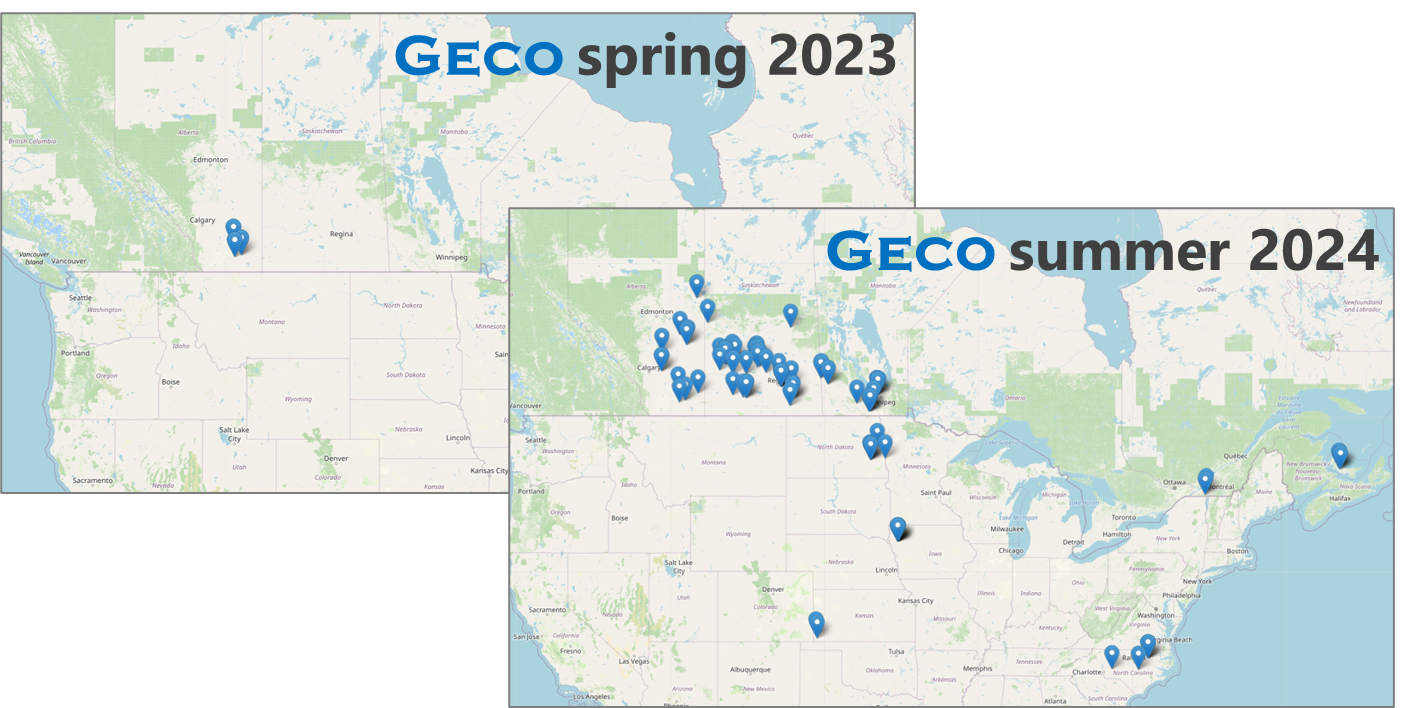
The difference in Geco’s footprint before engaging with EMILI versus today. Image provided by GECO
According to Greg, EMILI does two things for GECO.
1. Helps gather ground truth data through drone flights, and satellite data. GECO is able to run experiments from spring through fall, schedule multiple drone flights, and provide some scouting during the season. They are able to see weeds at different times of the year, and collect to show the effectiveness of their tools. Given the tests are independently run, it gives credibility and evidence to GECO.
EMILI works with GECO to help them design the experimentation protocol in an interactive fashion. It gives the opportunity for both sides to learn, and understand the project and infrastructure requirements.
GECO can use the data to improve the product, but there are some limitations on how the data can be used for marketing.
2. For early stage companies, it is important to get proof points, and capital. EMILI provides the infrastructure and micro-grants to fund specific projects for the entrepreneur. EMILI expects the startup to match their funds to showcase their skin-in-the-game.
I asked Greg what challenges they would face, if they didn’t have access to an organization like EMILI. Greg highlighted the challenges to get access to data from different sources like farm equipment, cost of hiring an agronomist, and timely access to fields to run their experiments in the right conditions. Given their initial market is farmers in the Canadian prairie, the EMILI innovation farm is a great resource for GECO.
Ukko Agro
EMILI provides weather station data to Ukko Agro to demonstrate how farmers can benefit from their crop growth and disease forecasting models to help better scout and know if, when, where to apply crop inputs. The three Ukko Agro weather stations on Innovation Farms are among over 50 sensors installed by EMILI across the farm in order to better understand similarities and differences in how they inform sustainable and profitable crop production decisions from field to field.
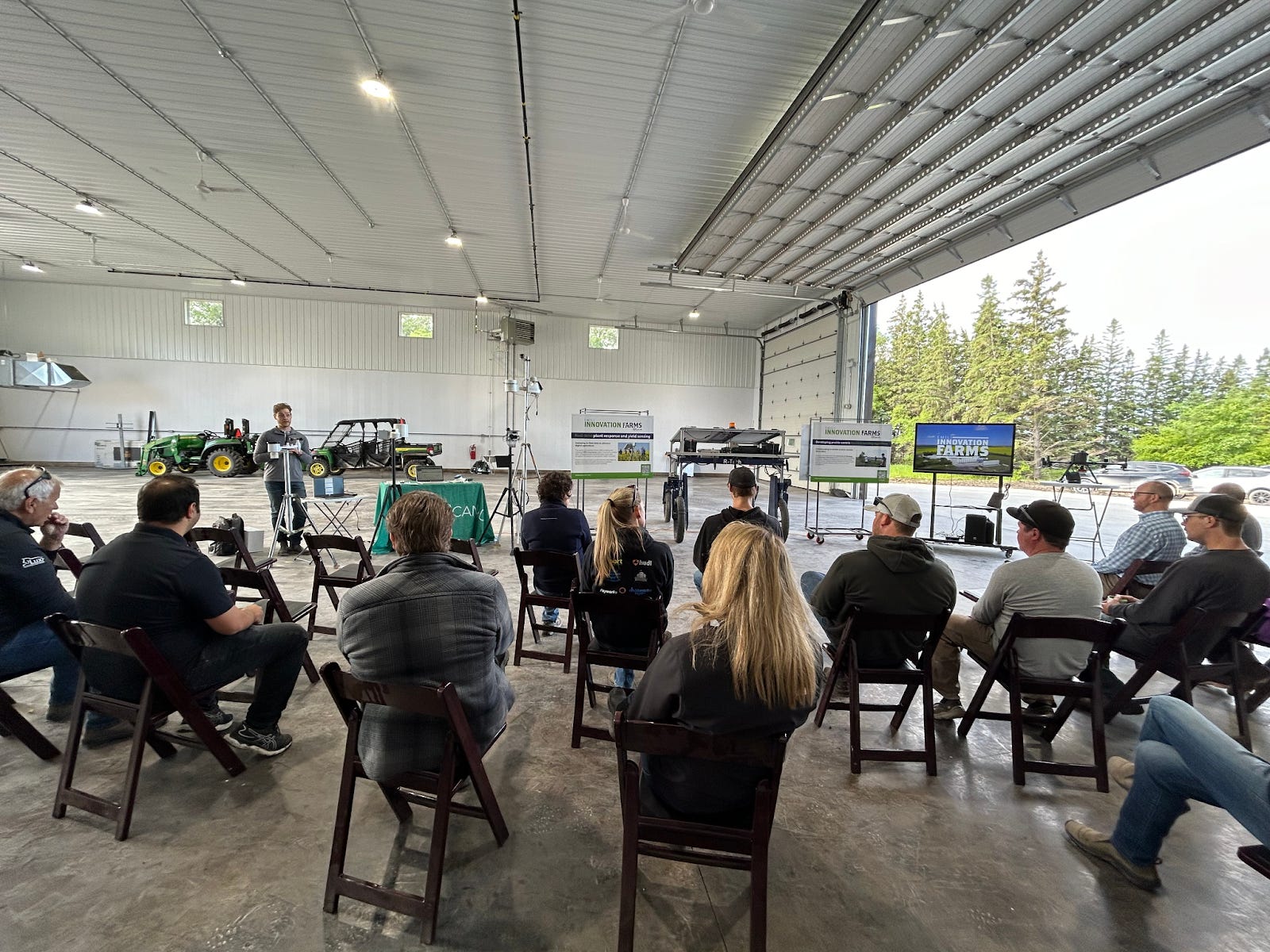
Ukko Agro at Producer Day (photo provided by EMILI)
AGI3
EMILI works with Agi3 to test and validate their Crop Sentry systems which collect daily multispectral point cloud and other sensor data throughout the season on crop growth, health, and yield. EMILI is able to bring the farm teams, and the technology teams together to help entrepreneurs hear directly from farmers. It allows entrepreneurs to understand localized features which are the most important and highest ROI for farmers.
University Research
In another example, EMILI is working with university researchers to develop a publicly accessible database of labeled plant and weed images which will train machine learning models for plant phenotyping, disease assessment, and weed management specific to Western Canadian crops. The data is accessible through the Digital Research Alliance of Canada. Researchers and others working in digital agriculture can access the information they need to accelerate the speed of innovation.
Success and future direction
When I asked Jaqueline about how they measure success, she pointed to success with scaling innovation for startups as a key indicator of EMILI’s effectiveness. EMILI wants to advance the integration of new technologies, and help innovators get better tuned to prairie risks and opportunities, and accelerate market adoption.
They want to increase awareness of the role of technology in agriculture through on-farm tours and events, online marketing and communications tools, and reach more people.
EMILI conducts field tours, such as a producer only day for farmers to ask questions and share insights. They hold an Innovation Demo Day to showcase emerging digital agriculture technologies to potential investors, government funders and community supporters.
Events such as 4R Day, Producer Day, and Innovation Demo Day helps EMILI demonstrate the productivity and sustainability of commercialized technologies, provide space to answer questions, inspire collaboration, and empower growers and others along the value chain to adopt and fully deploy digital tools.
EMILI is opening an Innovation Farms Centre, an 8,500 square foot space to host researchers, industry, and students for year-round activities. It will act as a venue to host farmer events and showcase learnings. It will help them support more innovators, and establish connections between entrepreneurs, the industry, and farmers. EMILI hopes to expand awareness of diverse career opportunities, and equip current and future workers in the agriculture and agri-food sector with the tools, knowledge and skills to make informed decisions about data and digital technology.
Equipping the agriculture and food sector with the right tools, knowledge, and skills to make the best use of data and digital technologies is central to EMILI. Activities such as providing data literacy training will continue to be a focus in the future.
Final Thoughts
Technology is rapidly changing the agriculture sector, with producers adopting satellite imagery, drones, visual recognition-assisted robotics, autonomous harvesting vehicles, and a range of sensors that feed continuous data on soil health, pest management, weather conditions, and more.
Scaling innovation is extremely hard and important to create impact. In agriculture, given the context-sensitive nature of problems and corresponding solutions, it is important that entrepreneurs have easy and economical access to test and iterate their products.
Organizations like EMILI provide excellent physical, digital, financial, and human capital infrastructure to entrepreneurs to help them test their innovations, accelerate product discovery, development and time to market for AgTech products.
Learning by doing requires doing.
References
Nurturing innovation, growing collaboration (Winnipeg Free Press)
Innovation Farms creates space to de-risk AgTech (EMILI Website)
AI could play major role in farms of the future (Globe and Mail)