

SFTW 2026
What will SFTW cover in 2026?

Welcome back to SFTW after an extended holiday break! A very happy 2026 to everyone!
There have been a few changes at SFTW over the last few weeks. The paid tier is disabled, and all past and future content is available for free to everyone.
As part of the move, I have also migrated from Ghost to Substack (though the old Ghost site is still up), as Substack is free if you are not charging your users. No change is required on your side. You can access all previous content on SFTW.
2025 has been a tough year for Agriculture and AgTech, to say the least.
The issues continue to be complicated, multi-faceted, and often (or always) there are no silver bullet solutions.
My last agriculture-related conversation in 2025 brought this home very strongly.
It happened at the Annual AgTech Alchemy event at Shapeshifter’s Cinema in Oakland, CA. I promise I was not in an inebriated state, even though the proprietor of Shapeshifter’s Cinema serves some fine home-brewed beer, and there was a generous supply of wine and bourbon!
The discussion was civil but very spirited when we began discussing water issues affecting California agriculture. We discussed automation technology, smart irrigation, water policy (e.g., SGMA), labor issues, supply chain infrastructure, and how each affects farming and food outcomes in the short term and the long term.
The discussion highlighted the challenges facing agriculture, particularly in resource utilization, policy changes, financing mechanisms, social and cultural issues, and scaling technology.
The discussion was a great reminder for me personally.
Technology is a great enabler for solving small and large problems.
But technology has to be adopted at scale for it to have an impact.
Adoption at scale requires the right business models, the right alignment of incentives, the right distribution networks, economic value creation for the ecosystem, stage and problem/solution-appropriate financing mechanisms, and the right policies in place (especially true in agriculture).
So what can you expect from SFTW in 2026?
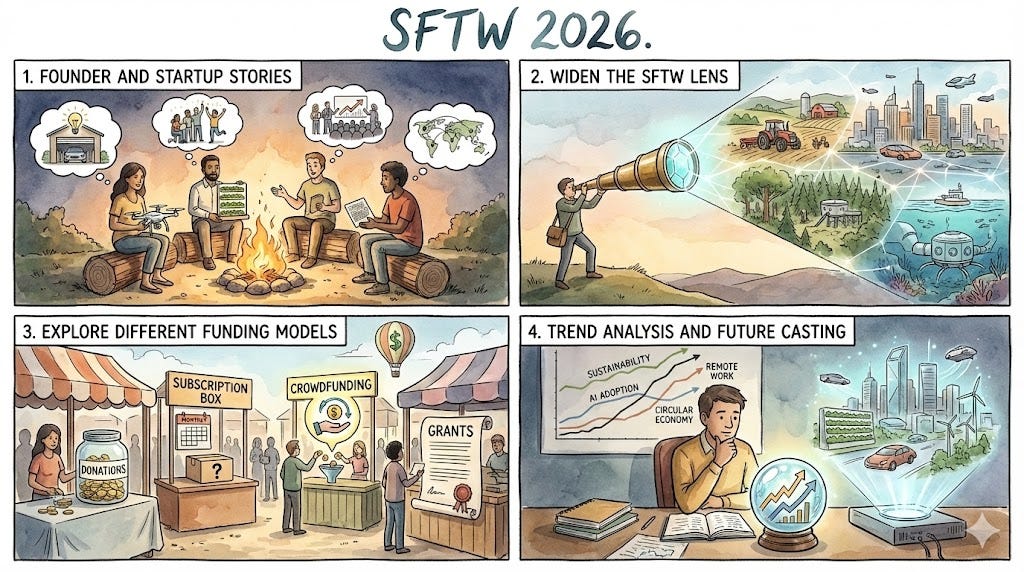
Founder and Startup stories
Passionate founders and startups play a critical role in any ecosystem, and agriculture is no exception. SFTW will continue to bring the perspectives of founders and their startups to the SFTW audience.
Widening the lens
SFTW will broaden its lens to examine how technology is adopted, from startups through scaling. SFTW will always take a technology-centered lens but will also consider other factors relevant to scaling technology, such as distribution, incentives, financing mechanisms, supply chain, and policy issues.
I recently signed on as a Senior AI Advisor to the Gates Foundation for its AI advisory work on smallholder farming, and you may hear more about it as well.
Funding models
In agriculture, it is fashionable to blame VCs for wasting money and not having a long-term perspective. Yes, many VCs can definitely be blamed for making bone-headed moves, but if every VC investment were successful, then it would not be called venture capital.
We need different funding models and approaches that align with the problem and solution type, technology maturity, and company growth stage. I had explored a few questions about this in last year’s seminar.
You will see more programming from SFTW in 2026 on this very important topic.
Trend Analysis and Future Casting
One of the most common types of questions I get is
Where do you think <a particular thing in ag> is heading?
Or
Where do you think <this concept/topic/idea/sector> will be in 5 years?
Or
What do you think will be the impact of <AI or some technology or capability> over the long term?
It is not easy to answer these questions, but I will do my best to provide my rationale for having a particular point of view. Many of these “future castings” will prove inaccurate, and I would appreciate your perspective on this topic.
Here’s to another interesting year ahead as we explore these topics together!
Happy to see you after long time vacation .