

Shifting Bottlenecks
The cotton gin and the cotton boom

First-order effects are obvious. They are the results that follow an action. Second-order effects are the harder-to-spot indirect effects. They represent a chain reaction in which a consequence produces a subsequent one, making them difficult to predict yet critical for long-term planning.
There is no better illustration of second-order effects than the evolution of America’s cotton industry.
Sea Island Cotton was the Lamborghini of cotton in the late 1700s and early 1800s. Prior to the 1790s, it was the only commercial cotton variety grown in the U.S.
“The Sea Island cotton, with its long, silky fibers, extraordinarily fine texture, and luxurious softness, could produce the very finest thread count, unparalleled by any other fabric in the world.”
Sea Island produced long staple, silky fibres that were highly valued by the British “upper class”. Think upstairs in Downton Abbey, or the “Ton” of Bridgerton.
The term “staple” refers to the length of cotton plant fibers used to weave a piece of cotton fabric. Shorter cotton fibers (“short staple”) are quicker to grow and therefore cheaper to produce and sell. When short-staple cotton fibers are used to make cotton fabric, the fabric is rougher, stiffer, and less durable.
Cotton goes through multiple steps from the field to the gin. Cotton is picked in the field during harvesting, and it is then transported to the gin, where it is dried, cleaned, separated into lint and seeds, and prepared for further storage.
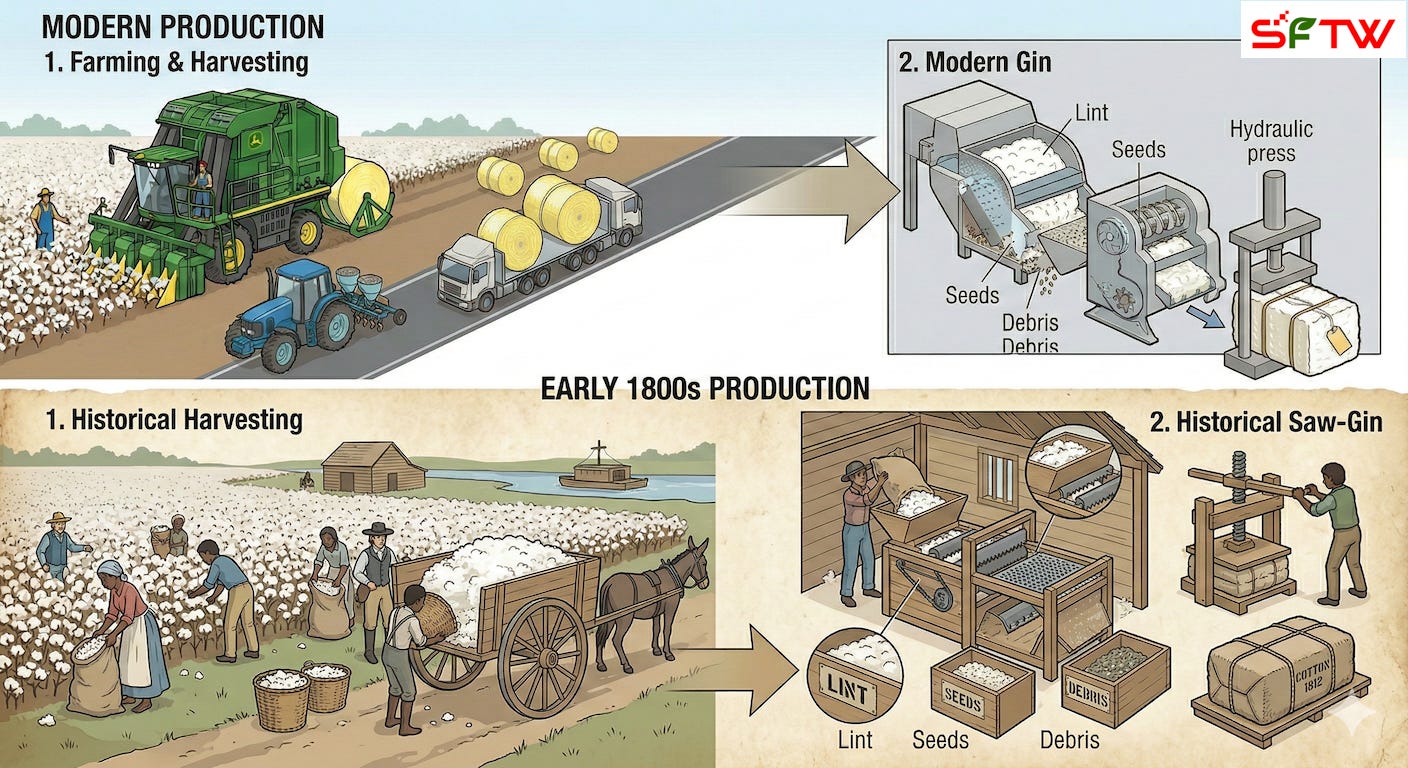
Cleaning was the first bottleneck
Harvesting Sea Island cotton was relatively easy. It had smooth, black seeds. If you pinched the lint, the seed would pop out easily. It was highly profitable because it was easy to clean by hand or with a simple, ancient hand-cranked roller gin.
The Sea Island variety was very fragile to grow. It required a very long, frost-free growing season and high humidity. It could only be grown on the barrier islands and immediate coastlines of South Carolina, Georgia, and Florida. If you planted it inland, the frost would kill it.
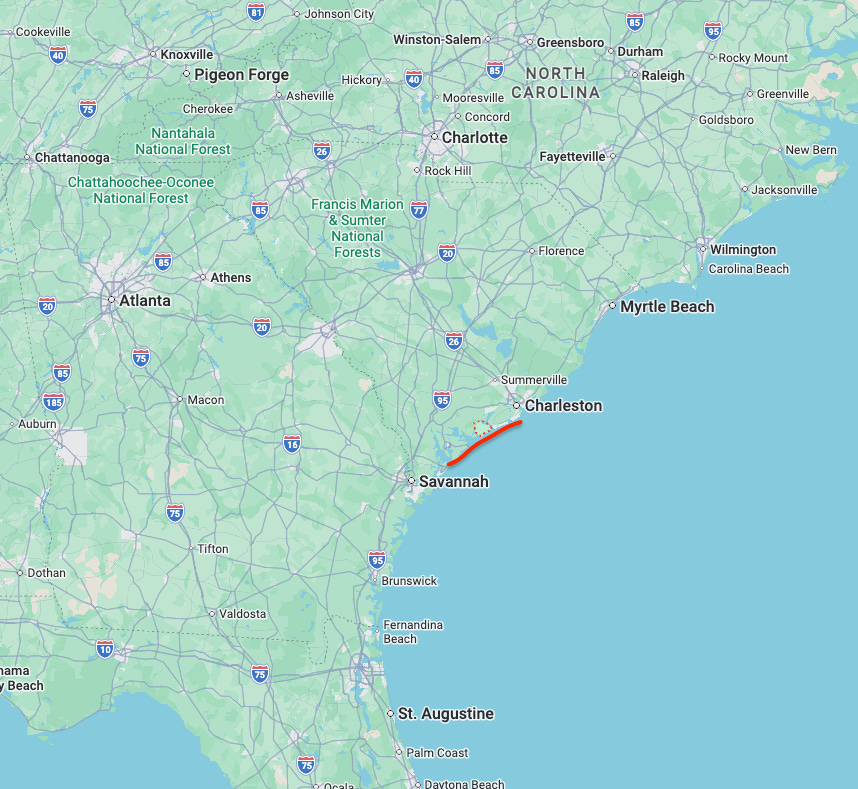
Farmers of the time were aware of another variety called Upland cotton, which had a short staple. Upland was a tough, robust plant that could survive the colder winters and drier soils of the inland American South. Unlike Sea Island cotton, Upland had fuzzy, green seeds that stuck to the fiber like superglue.
It was extremely difficult to separate the lint from the seed. It took an enslaved worker an entire, grueling day to clean just one pound of short-staple cotton by hand. Because the labor cost of cleaning it vastly outweighed the price it could fetch in England, Upland cotton was considered a worthless weed for commercial export.
No one had grown Upland cotton commercially before 1793.
But Eli Whitney invented the cotton gin to specifically solve the “sticky seed” problem of short staple cotton. Whitney’s gin, instead of rollers, used a cylinder with wire teeth (subsequent versions used circular saws) to pull the cotton through a narrow wire grid. The lint passed through, but the sticky seeds were too big and were stripped away.
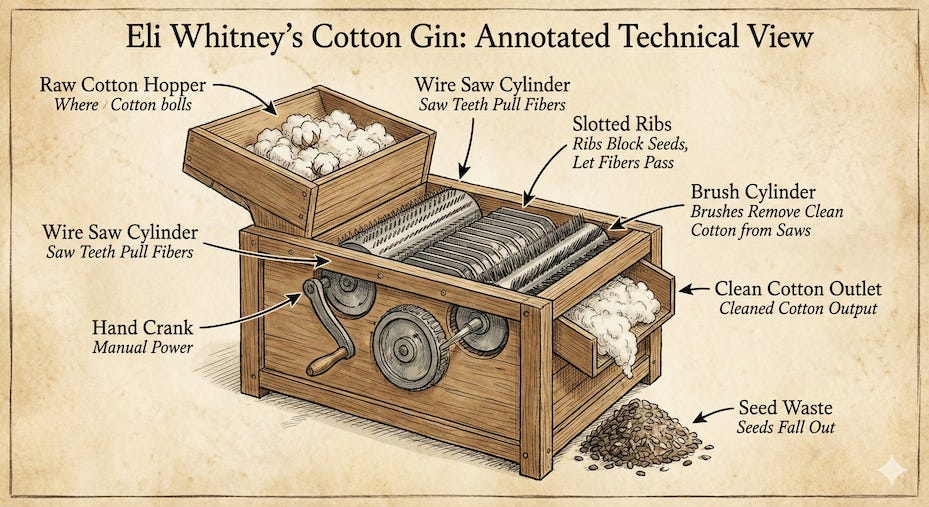
A single hand-cranked Whitney gin could clean 50 pounds of short-staple cotton like Upland per day. Now it was feasible to grow cotton inland.
The gin made short-staple cotton profitable by “easing the removal of seeds from the cotton boll” problem. The planters were no longer confined to the coast, as Upland cotton could grow anywhere in the South.
The Whitney gin shifted the bottleneck from cleaning cotton to planting and harvesting cotton inland.
This completely inverted the economics of cotton production. It triggered a massive, violent land rush and opened up millions of acres of newly-prime inland real estate specifically for short-staple cotton plantations. The planters required significant labor to plant, cultivate, and harvest large quantities of cotton.
The United States was already exporting cotton to England. The British textile industry mechanized in the early 19th century. Power looms and spinning jennies in Manchester created an insatiable, bottomless demand for raw fiber. Britain didn’t care that short-staple wasn’t as luxurious as Sea Island; they just needed massive volume to feed their factories.
It massively expanded and entrenched slavery as a profitable labor system. The enslaved population in the South grew from 700,000 in 1790 to nearly 4 million by 1860, with cotton becoming “King Cotton” and accounting for 50–60% of U.S. exports.
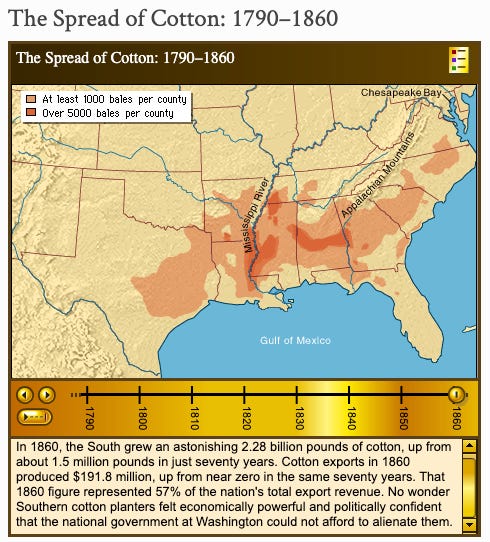
In 1790, the U.S. produced about 3,000 bales of cotton, whereas by 1860, on the eve of the Civil War, the U.S. was producing nearly 4 million bales a year (mostly short-staple Upland) and provided about 75% of the entire world’s cotton supply! (A bale of cotton is roughly 480 to 500 pounds).
Today, the Upland variety accounts for 97% of US production, with Pima (a long-staple variety) accounting for the remaining 3%. The states that produce the most Upland cotton in America include Texas, Georgia, and Arkansas. California is the top producer of the Pima variety.
The next obstacle was picking
Whitney always intended the gin to reduce reliance on labor. But it would take another innovation in the following century to reduce the reliance on any kind of human labor. (including the abolition of slavery)
When cotton is picked, roughly 60% to 65% of its weight is the seed, and only about 35% to 40% is the valuable lint. Hauling loose seed cotton long distances to a massive, centralized “cotton elevator” (processing facility) would mean farmers were paying to transport immense bulk and weight, most of which was low-value seed.
A cotton plant doesn’t open all its bolls at once. A single field might be picked over three or four times by hand from late August straight through to December. This created a slow, steady stream of seed cotton that could be taken directly to the local gin in wagonloads as it was picked, eliminating the need for massive, sudden storage capacity.
Because of this, the economic incentive was to gin the cotton as close to the field as possible. Instead of centralized storage silos, as with grain, the South built a highly decentralized network of thousands of local, community-level cotton gins. In the late 1800s and early 1900s, almost every small farming town in the South had its own gin.
The bottleneck in overall production was harvesting speed, not ginning speed.
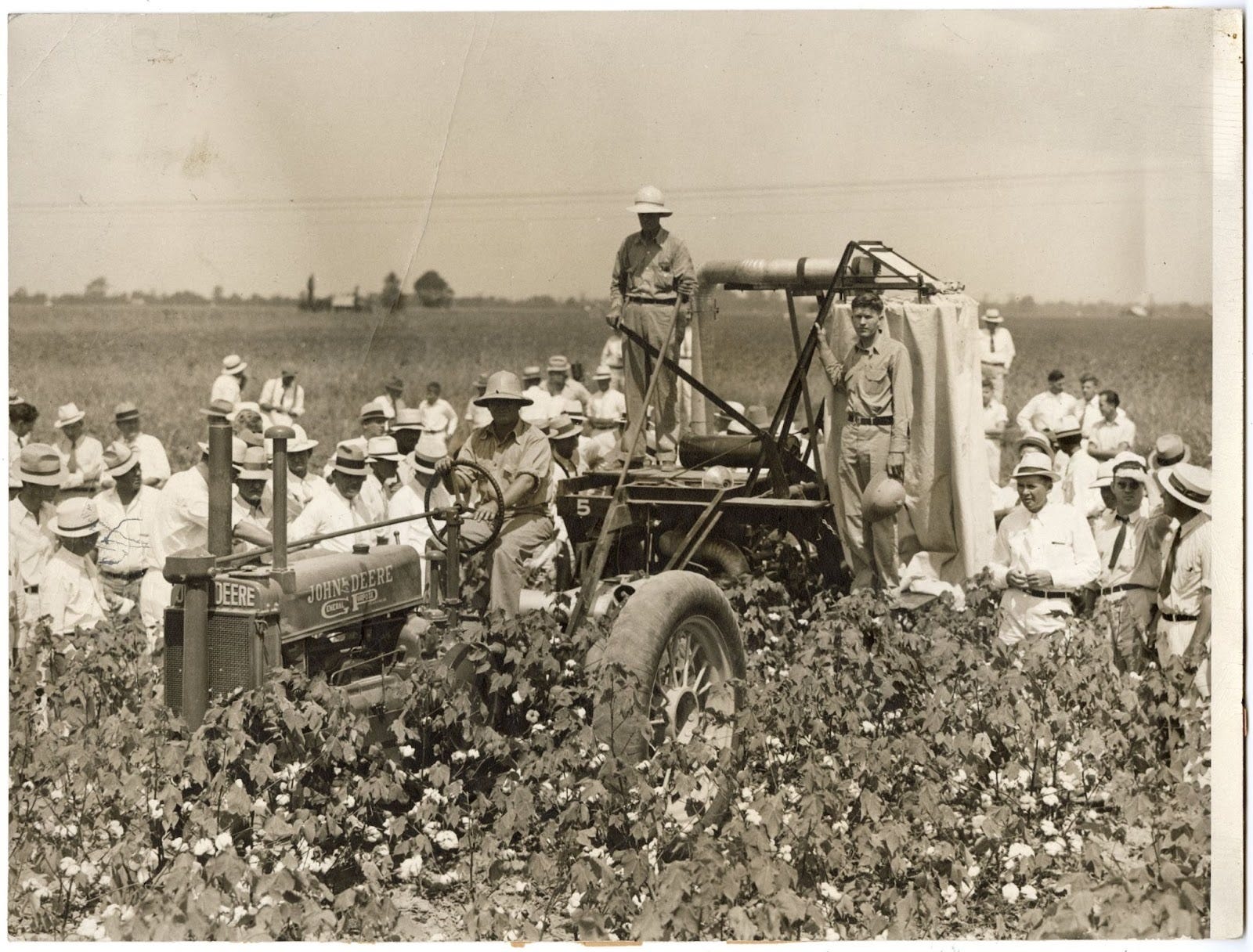
In the 1940s, a new mechanical cotton picker designed and patented by John Rust became popular. The widespread adoption of mechanical spindle pickers and strippers in the 1940s and 50s meant that a machine could harvest in a few hours what had previously taken a human crew an entire week to harvest.
The bottleneck shifted from harvesting speed to ginning speed after cotton had been harvested. Suddenly, the local gins were overwhelmed.
Mountains of loose cotton piled up in trailers in gin yards, waiting to be processed. Small, older gins could not keep up. To survive, a gin had to invest in larger, faster machinery (bigger saw gins, massive natural gas dryers, and automated presses). Those who couldn’t afford the capital upgrades were forced to close.
The expansion of paved rural roads and the use of motorized trucks meant a farmer was no longer restricted to the gin just two miles down the dirt road. A farmer could easily load a truck and drive 20 miles to a larger, faster, and cheaper gin, destroying the “one gin per town” monopoly.
It led to a sharp decline in demand for manual agricultural labor and resulted in a rapid consolidation of farms (fewer, larger operations) and a shift from labor-intensive to capital-intensive agriculture.
It drastically reduced the number of cotton gins from more than 25,000 at the beginning of the 20th century to about 1,000 at the beginning of the 21st century. Today, according to the USDA, there are only 446 active cotton gins in the United States.
Farmers were picking cotton faster than they could process it
Before 1971, cotton was hauled in wire mesh trailers. If the gin was backed up, the farmer’s trailers were stuck at the gin, meaning the harvester in the field had to stop working because it had nowhere to dump the cotton. Even if a farmer had redundant trailers, the picker was much faster compared to how much cotton could be processed by the nearest gin, when the cotton was coming from multiple farmers
The final blow to the small, local gin arrived in 1971 with a Texas A&M engineering invention.
The cotton module builder compacted the cotton into a massive, dense, freestanding brick right on the edge of the field. It decoupled the storage from the cotton ginning. The cotton could safely sit on the ground under a tarp protected from the elements. This allowed the farmer to keep harvesting indefinitely without buying a single extra axle or tire, while specialized trucks shuttled the modules to the gin at a steady, manageable pace.
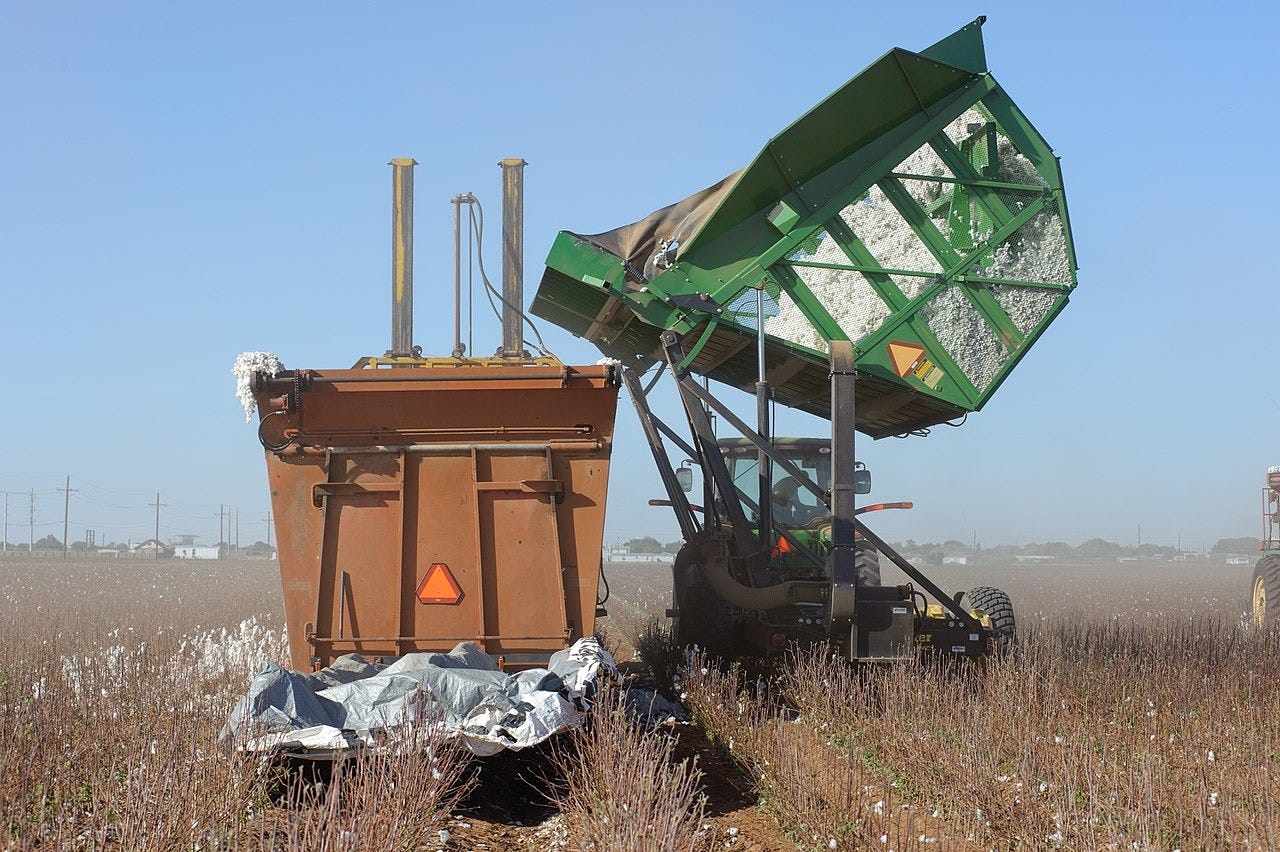
Because the cotton could now sit safely at the edge of the field for some time, the frantic rush to the local gin was reduced. Gins no longer needed to be within 20 miles of a farm. This allowed multiple small gins to merge into single “mega-gins” that could pull modules from a 100-mile radius and operate continuously through the winter.

Store and don’t stop harvesting
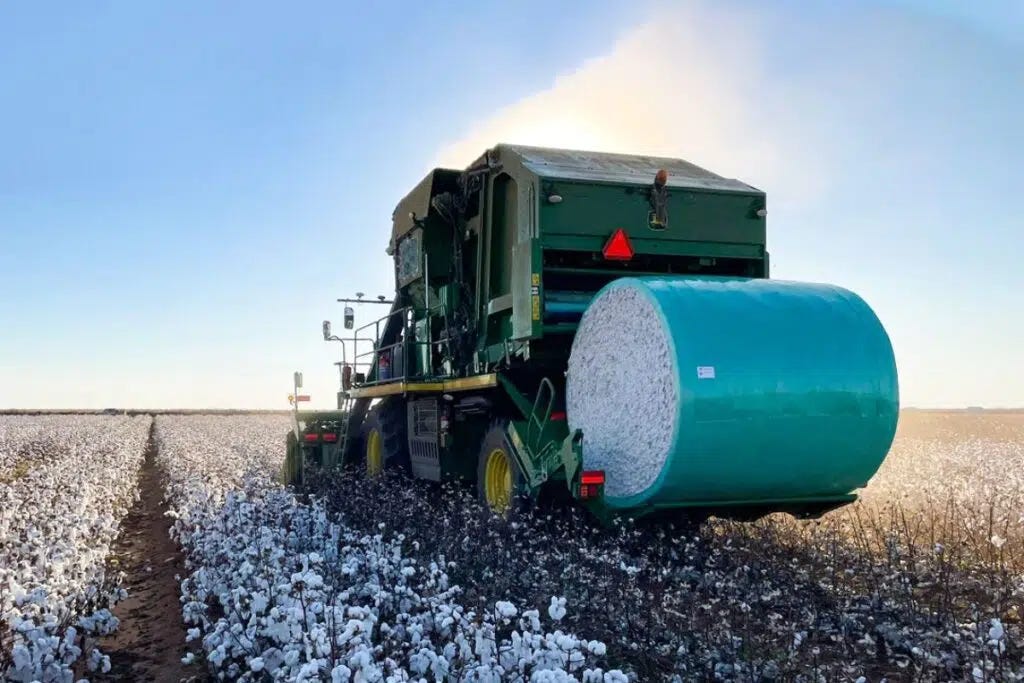
Another major technological change occurred in 2007, when John Deere introduced an on-board wrapping capability. It eliminated the need to stop the harvester to dump cotton and protected the cotton from rain with plastic wrap.
As the modern harvester drives through the field, it builds, wraps, and drops a 5,000-pound round module out the back without ever stopping. A support tractor equipped with a specialized front-end loader or hydraulic “spear” drives through the field, picks up the dropped modules, and lines them up perfectly at the edge of the field (the turn-row). They are often grouped in sets of four or six, perfectly spaced for a truck to load them quickly.
Before 2007, if a farmer bought another 1,000 acres, the farmer had to buy another harvester, a boll buggy, a module builder, and hire four more people. The round-module harvester allowed one person to do the work of a whole crew. Freed from the labor bottleneck, large farming operations rapidly bought up smaller farms, leading to massive consolidation of farmland.
It drastically reduced farm labor needs (from 5 people to 1) and allowed gins to store cotton outdoors for months, triggering the massive consolidation of small farms and local gins into “mega-operations,” and further reducing the number of cotton gins in the U.S.
The old, rectangular cotton modules required highly specialized, expensive “chain-bed” trucks to winch the 32-foot loaf onto the truck bed. Round modules changed the game by making transport more modular.
Round modules are designed to fit onto standard flatbed trailers. A typical flatbed can hold four to six round modules. Because they are just heavy cylinders, a forklift or tractor can load a truck in minutes. This allows a small fleet of trucks to continuously cycle between the farm and the gin, moving massive tonnage with very little downtime.
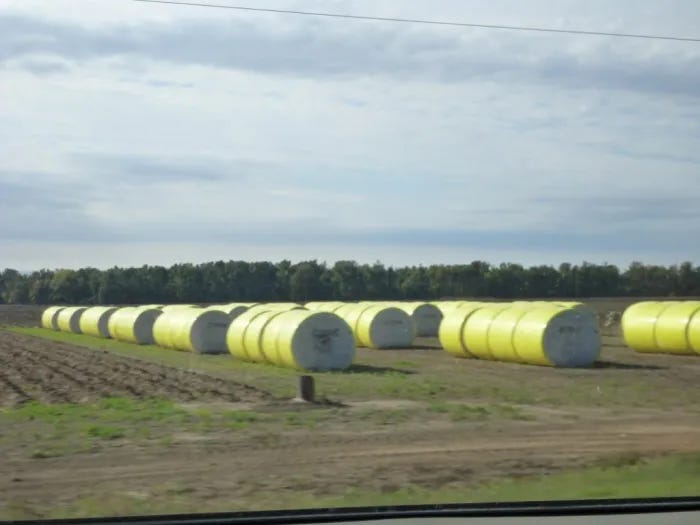
When the trucks arrive at the gin, they don’t immediately dump the cotton into the machinery. They unload the modules into a massive, meticulously organized staging area called the “gin yard.” Because the plastic wrap protects the cotton from rain and snow, the gin yard acts as a giant outdoor warehouse.
You will often see tens of thousands of round modules lined up in perfect rows spanning dozens of acres. This “buffer” allows the gin to operate 24/7 at a steady, efficient pace from October through February or March, long after the farmers have finished harvesting.
Conclusion
Throughout the history of cotton, a new technology innovation, whether it was cotton picking, separating the seed from the bolls, or storage on the field with little or a lot of protection from the elements, shifted the bottleneck for the overall throughput and efficiency of the process to a different operation.
A technological change triggers known first-order and often unanticipated second-order changes.
One way to analyze and anticipate second-order effects is to understand how the new technological change is shifting constraints and bottlenecks, and which processes were held back by the old constraints.
This type of thinking will be especially important within food and agriculture as we consider the impact of slowing population growth and eventual decline, an aging population, GLP-1s, automation, and AI.
I want to thank Mike Riggs, Elizabeth Van Nostrand, and Abby ShalekBriski for their review and feedback. Any errors are obviously my responsibility.