

The (al)Most Water-Efficient Almonds
Most future almond water efficiency might not be driven by technology

This is a continuation of the supply chain series, focusing on water as a key constraint for almonds and how it drives many cropping practices, policies, technology, and economic decisions. While precision irrigation technology is very important, any major future improvements in water efficiency in almond growing will come from other sources, such as policy and geography. The technological improvements in digital management might be approaching an asymptote with the current set of assumptions.
Programming Note: Starting with today’s edition, you can expect to receive an SFTW newsletter every other Wednesday.
Water access might be an easier challenge for AI than almonds.
I am at a Blue Bottle Coffee shop in San Francisco, getting a latte with almond milk. The common discussion is all about AI, with San Francisco being the AI capital of the world. Along with crazy talk about a permanent underclass, the future of society, and dramatic GDP growth, the amount of water used by AI data centers is a topic of discussion in certain circles.
If you go 80 miles east of San Francisco to Ripon, CA, water is a very big and even more consequential topic of discussion. Ripon is the self-proclaimed “capital of the world for almonds.”
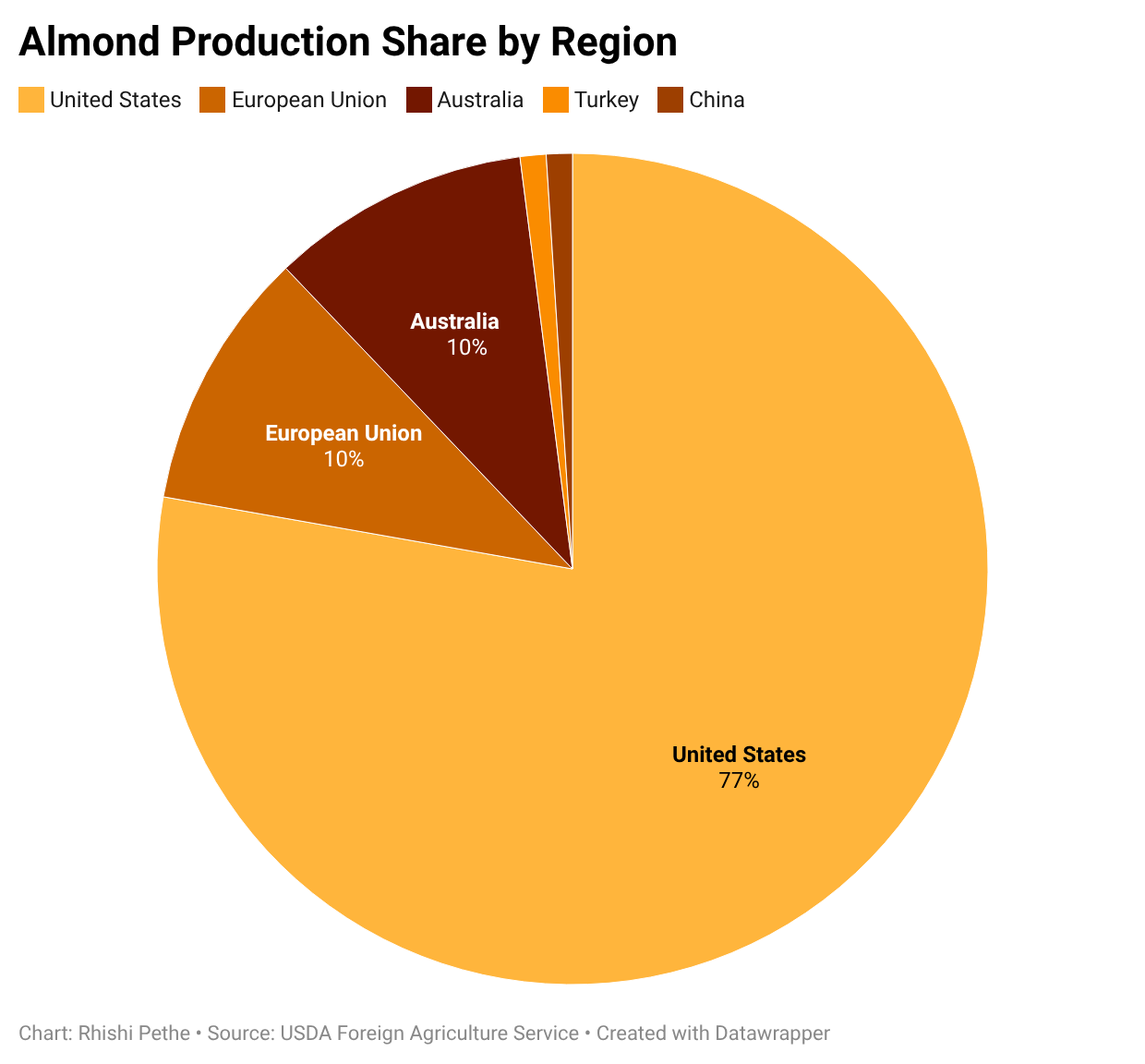
Almonds and water are a big discussion in California, as the state produces about 70-80% of the world’s production of almonds.
I am sure you have heard stats like you need more than a gallon of water to grow a single almond. It takes hundreds of gallons of water to produce a gallon of almond milk.
If you think these ratios are skewed, they were much more skewed about 30 years ago. The California almond industry and the ecosystem around it, along with regulatory changes, have increased water-use efficiency for almonds by 30-50% over the last four decades. Most of the changes in almond growing in California have been driven by the availability (or lack thereof) of water.
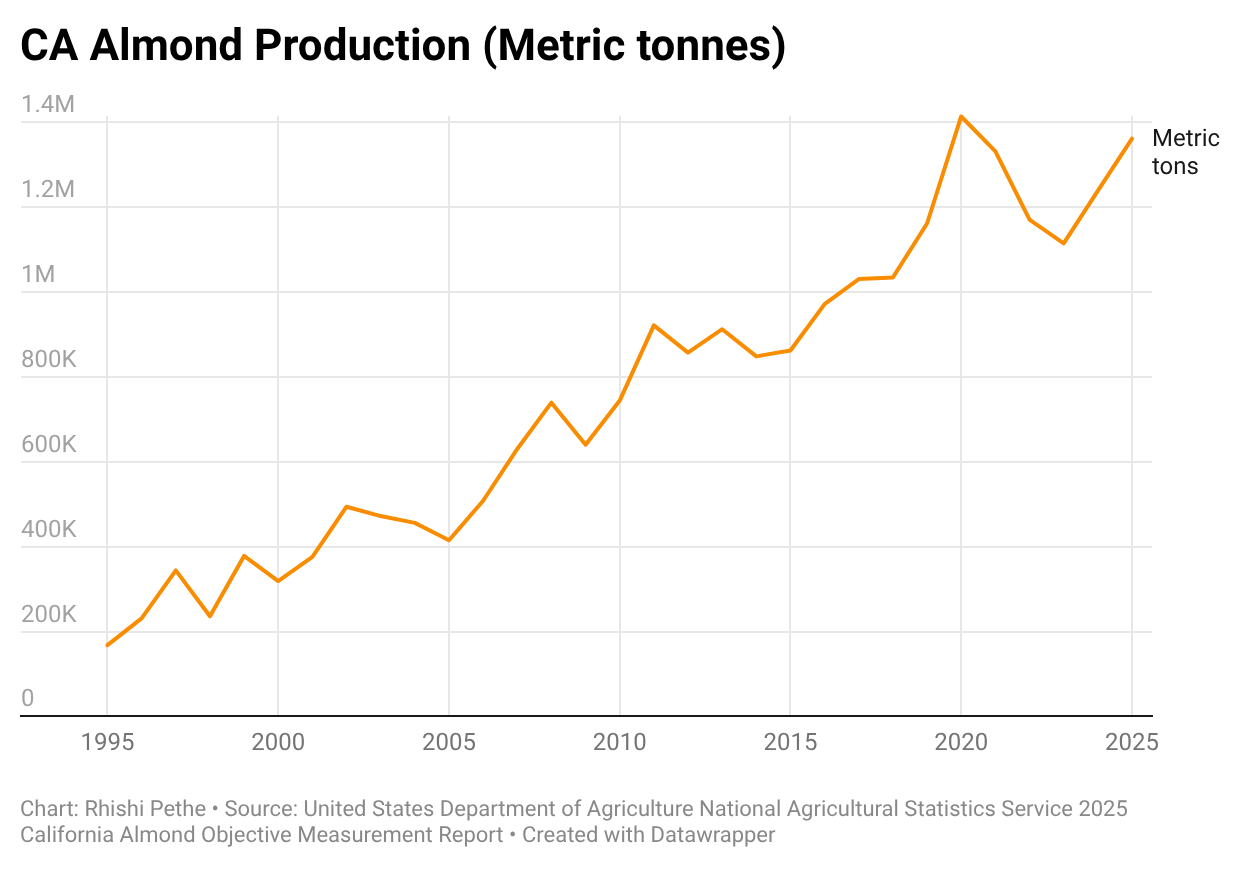
The big picture is that California’s average annual water supply has not cratered over the last forty years. The big changes have been in the volatility, timing, and type of water available, prompting changes in cropping practices.
Doing shots vs. sipping wine
The snowpack in the Sierras is declining and shifting earlier. The April snowpack across the Western US has declined by 24%1, with Northern California among the most affected in the last fifty years. Historically, the snowmelt from the Sierra Nevada provides roughly 75% of California’s agricultural water.
The snowpack acted as a slow-release medication, melting gradually, but rising temperatures have shifted the timing to a flash-flood profile. The state’s surface water reservoir infrastructure, designed in the mid-20th century to receive snowmelt steadily, cannot handle water that overflows and is lost to the sea.
At my age, it is like what happens if I do Tequila shots instead of sipping wine. I cannot handle it, either things overflow or I get dehydrated.2
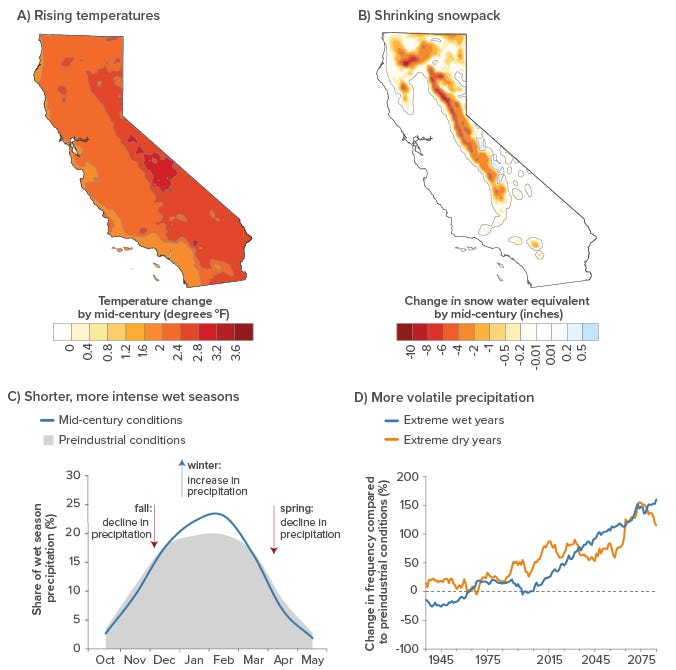
The volatility in the water available from the snowpack has prompted significant groundwater withdrawal from the region3.
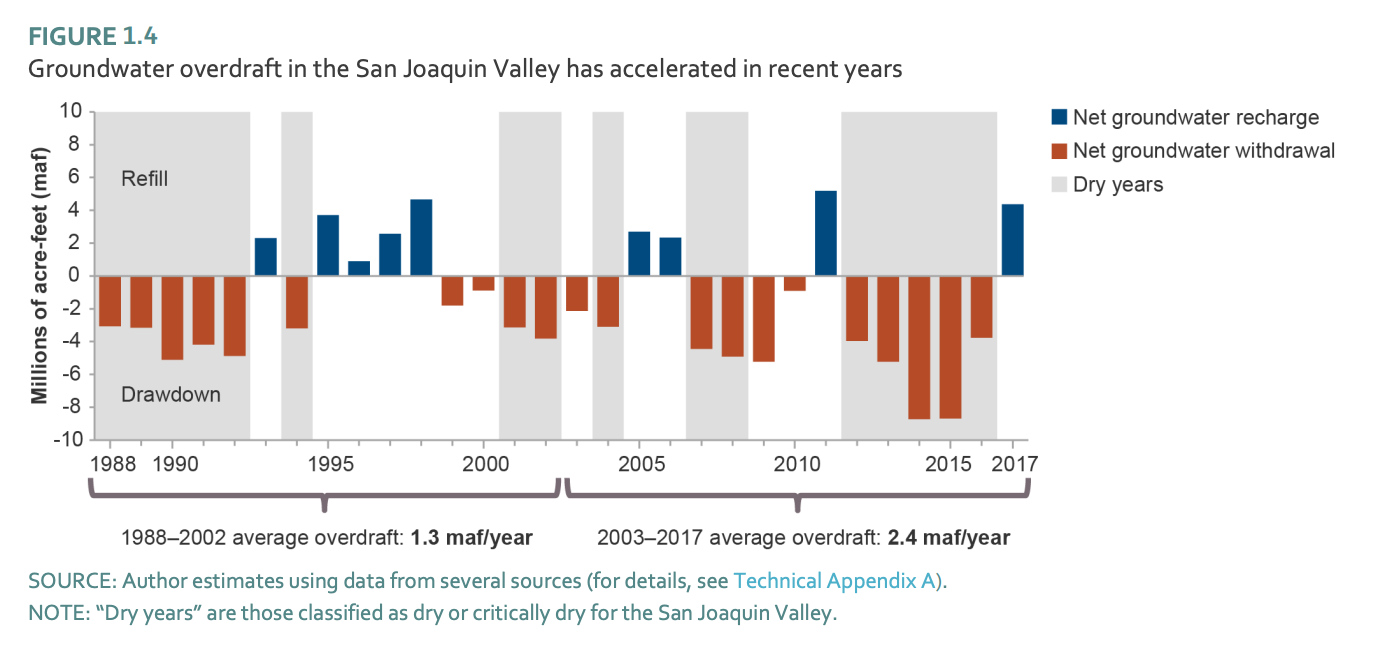
According to the State Water Resources Control Board,
Groundwater is one of California’s greatest natural resources. In dry years, it makes up to 60 percent of the state’s total water supply, serving as a buffer against the impacts of drought and climate change. Even when California has adequate precipitation, groundwater still makes up to 40 percent of the state’s total water supply. Groundwater is vitally important to California’s agricultural industry and is a major source of the state’s drinking water.
The California State Legislature adopted the Sustainable Groundwater Management Act (SGMA) in 2014 to protect and regenerate California’s groundwater, but there has been some sharp criticism around SGMA due to its economic impact.
Five five-year plans with volatile budgets
Imagine you are a mandarin in the CCCP or during Soviet Russia. You are responsible for creating the next five-year plan. Your job is extremely difficult because you don’t have visibility into inflows and outflows over the next five years.
You try your best and bake in a set of assumptions, based on bad data. Now multiply that by five times and imagine you have to do a 25-year plan. This is what it feels like when you are planning an almond orchard, when it comes to water availability during an almond orchard’s life span.
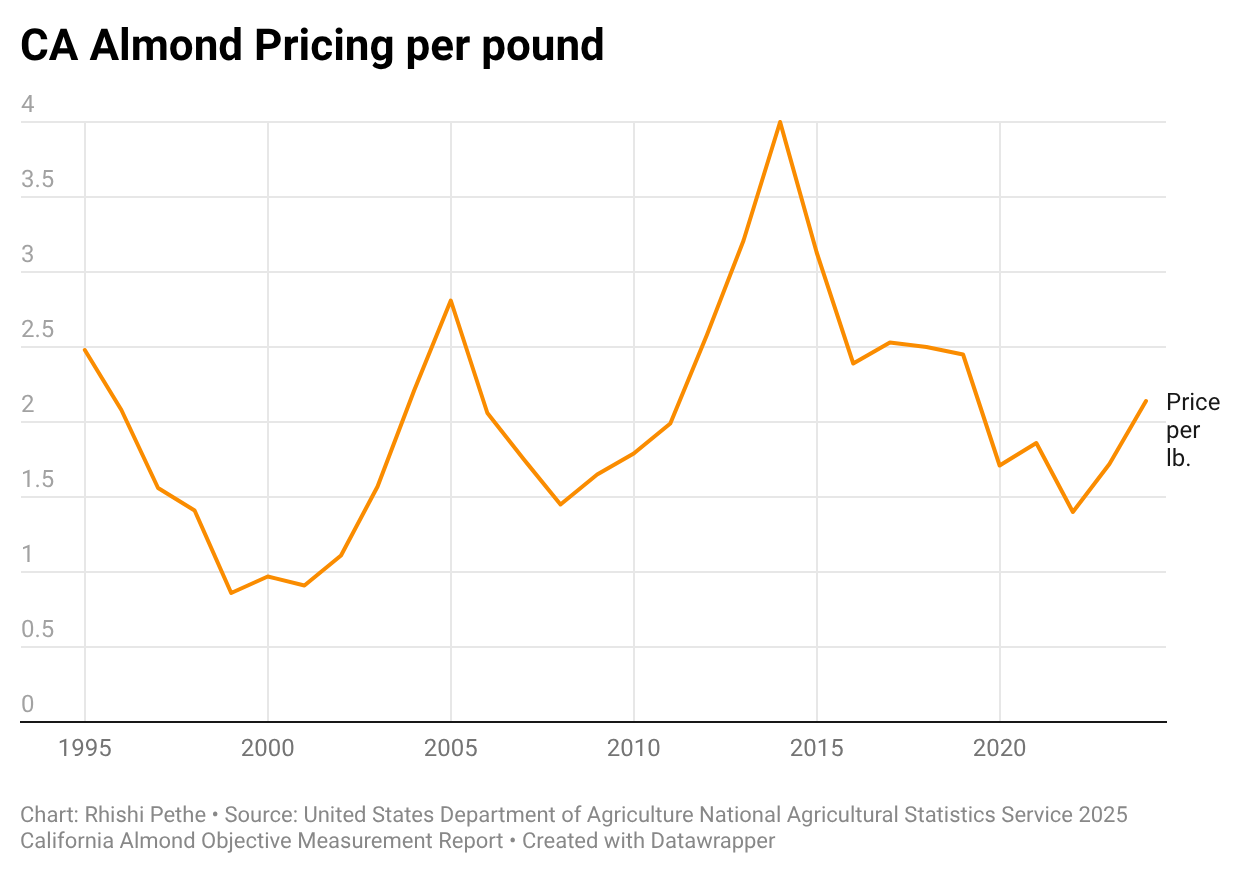
An almond tree’s productive, commercial lifespan is about 25-30 years. While trees can live for 40–60 years under ideal conditions, commercial orchards are typically removed after 25 years, when yields begin to decline. Peak production occurs between years 5 and 15.4
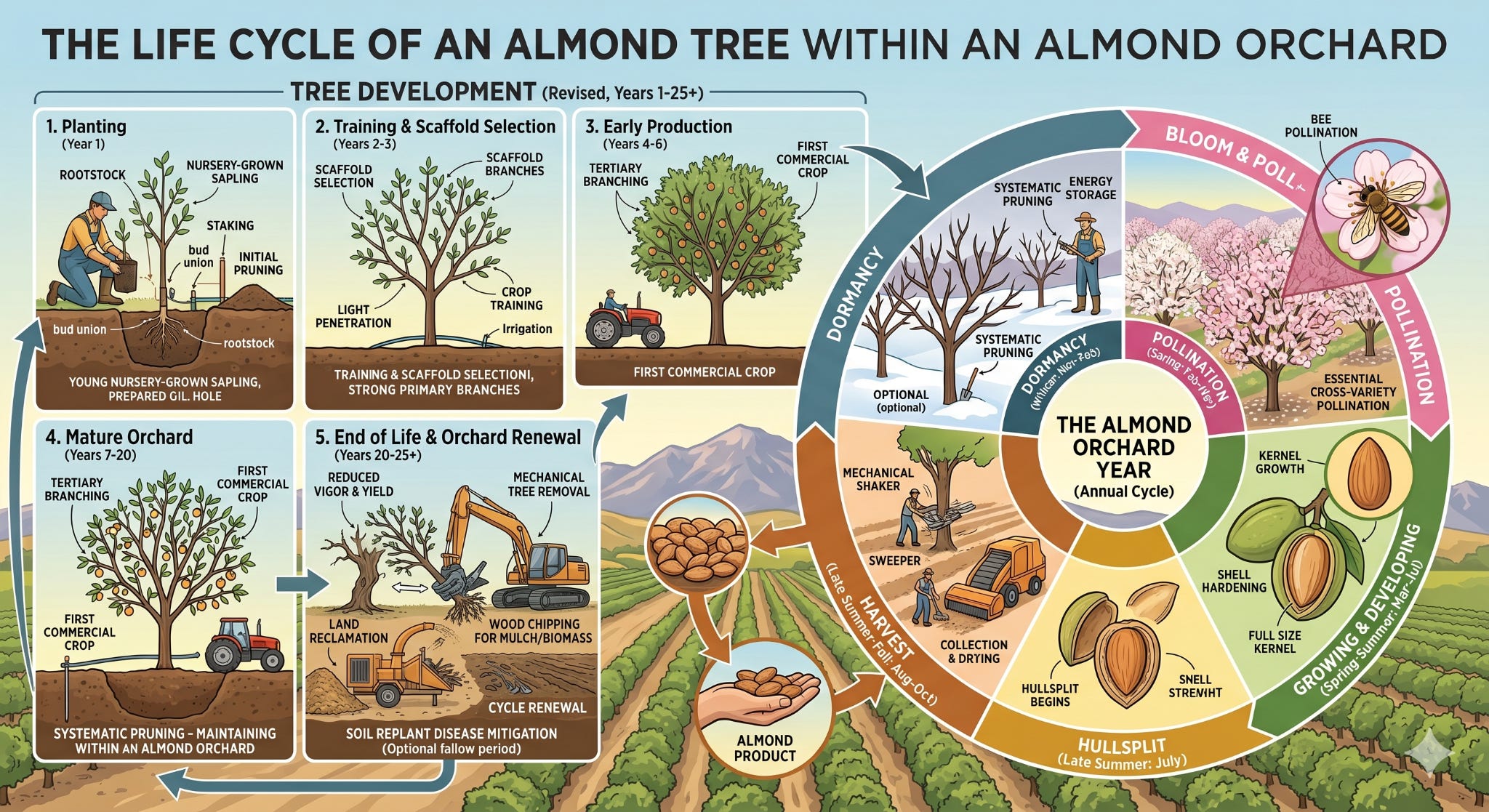
It is extremely difficult to model the volatility in water availability in California over a 25-year period. Old assumptions around water storage, the timing and quantity of water flow, and most importantly, the expected price of water do not hold true. Also, a water deficit in one year cannot be caught up with a water excess in the next year, as both less water and more water are not beneficial for the tree’s fruit potential.
Growers have had to plan on the assumption that they might not get all the water they need every year for twenty-five years in a row. The agricultural ecosystem has responded proactively to manage water issues associated with almond cultivation. Growers have had to manage so that the almond trees and orchards need much less water, allowing them to ride out the low end of water availability over a 25-year cycle.
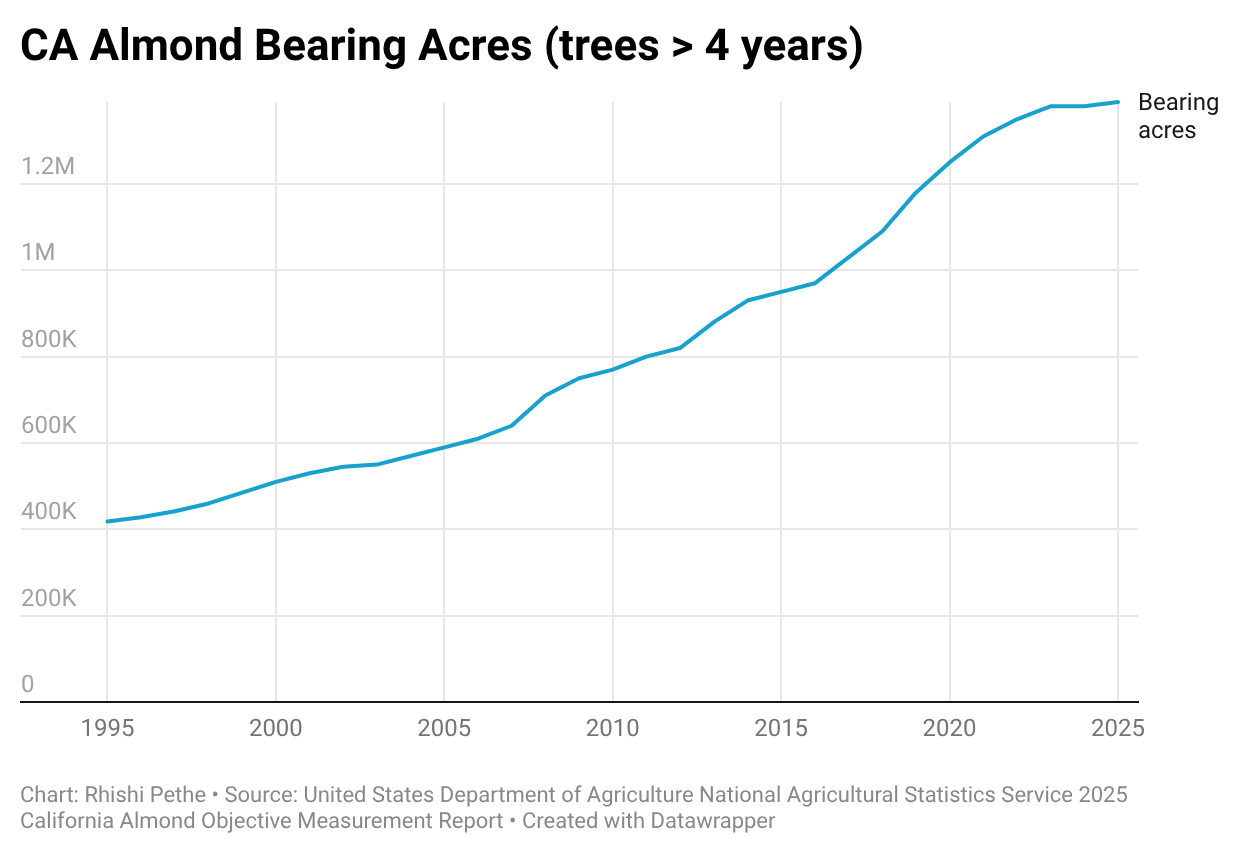
For example, the Almond Board has cited a one-third reduction in water per pound for many years.
Improving Water-Use Efficiency
Changing the irrigation method
In the 1980s and 1990s, most almond growers followed flood-and-furrow irrigation. Flood and furrow irrigation in almond orchards is a surface, gravity-based method for delivering water. Flood irrigation covers the entire orchard floor, while furrow irrigation uses small trenches along tree rows, applying water only to specific areas to reduce usage. This method of irrigation was used to recharge groundwater, or when there was not enough capital to invest in micro-irrigation.
Most growers have moved from flood-and-furrow irrigation to micro-irrigation. Micro-irrigation, including drip and micros-prinkler systems, is used on over 80% of California almond farms to increase water-use efficiency by targeting water directly to the root zone. This type of irrigation ensures that 90-95% of the water is available to the almond tree roots, compared to much lower percentages with flood and furrow irrigation. This approach minimizes evaporation and runoff, supporting sustainable production while reducing water consumption per pound of almonds by 33% over the past two decades.
The move to drip and micro-sprinkler systems required capital investment, but it protected growers from the downside of water availability as long as water availability didn’t drop by more than a third.
A shift from calendar-based to evapotranspiration-based irrigation occurred in the 2000s and 2010s. Evapotranspiration (ET) based irrigation in almonds is a precision water management strategy that calculates the exact amount of water lost from the soil (evaporation) and the trees (transpiration) to determine how much irrigation water needs to be replaced. It ensures trees receive optimal water throughout the season, maximizing yield while minimizing waste.
Almond orchard evapotranspiration (ETc) is calculated by multiplying the weather-based reference crop (ETo) by a canopy-based crop coefficient (Kc). The weather-based reference crop (ETo) is available primarily from the California Department of Water Resources’ CIMIS network of nearly 145 weather stations, which provide daily reference evapotranspiration values.
Calendar scheduling treats the orchard water demand as constant. ETo scheduling treats it as a daily-varying physical quantity. The same orchard, on the same soil, with the same trees, can use 20–30% less water under ETo scheduling than under calendar scheduling, simply because the calendar approach systematically over-irrigates during cool weeks and shoulder seasons.
Precision Irrigation
Modern California almond orchards have largely converted from flood-and-furrow irrigation to micro-irrigation. These are drip and micro-sprinkler systems that deliver water to the root zone with minimal evaporation, runoff, or deep percolation losses. The Almond Board reports that micro-irrigation adoption accounts for roughly 85% of California almond acreage. This shift happened between the late 1980s and the early 2010s.
The precision-irrigation layer that sits on top of micro-irrigation and ET scheduling. This includes soil moisture sensors at multiple depths (tensio-meters, capacitance probes, neutron probes), stem water potential measurement using pressure chambers, and an emerging set of remote-sensing tools. It adds an additional 10-20% efficiency on top of what is already shaped by upstream decisions.
Genetics
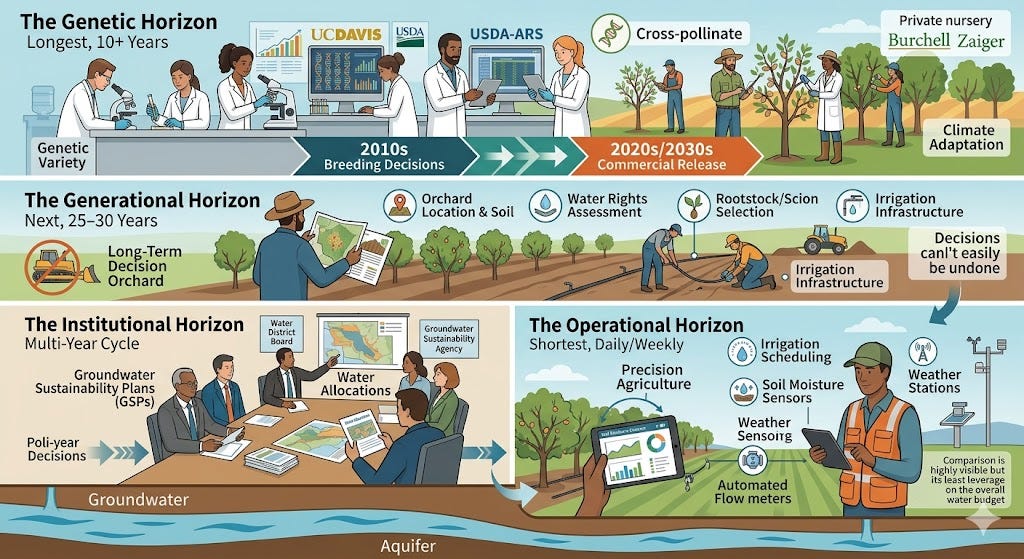
The genetic decisions that govern an almond orchard’s water use are made in two places. The rootstock (the underground tree onto which the productive variety is grafted) and the scion (the productive variety itself). Both are bred over decade-long timelines by a small community of geneticists.
The rootstock determines how the tree extracts water from the soil. The root architecture, its tolerance to salinity, its drought response, and its ability to handle waterlogged or compacted soil play a role. Different rootstocks are different machines with different water curves.
For example, UC Davis breeder Tom Gradziel’s program has produced 14,000-plus seedling progeny in recent cycles, screened for a long list of traits (yield, kernel quality, harvest timing, pollinizer compatibility, disease resistance). Drought tolerance is on the list, but is not the top selection criterion.
Improvements in genetics take more than 10 years to come to fruition, and often the water-efficiency improvements will be gradual rather than a step change.
Reducing overall water usage
Throwing good water after bad
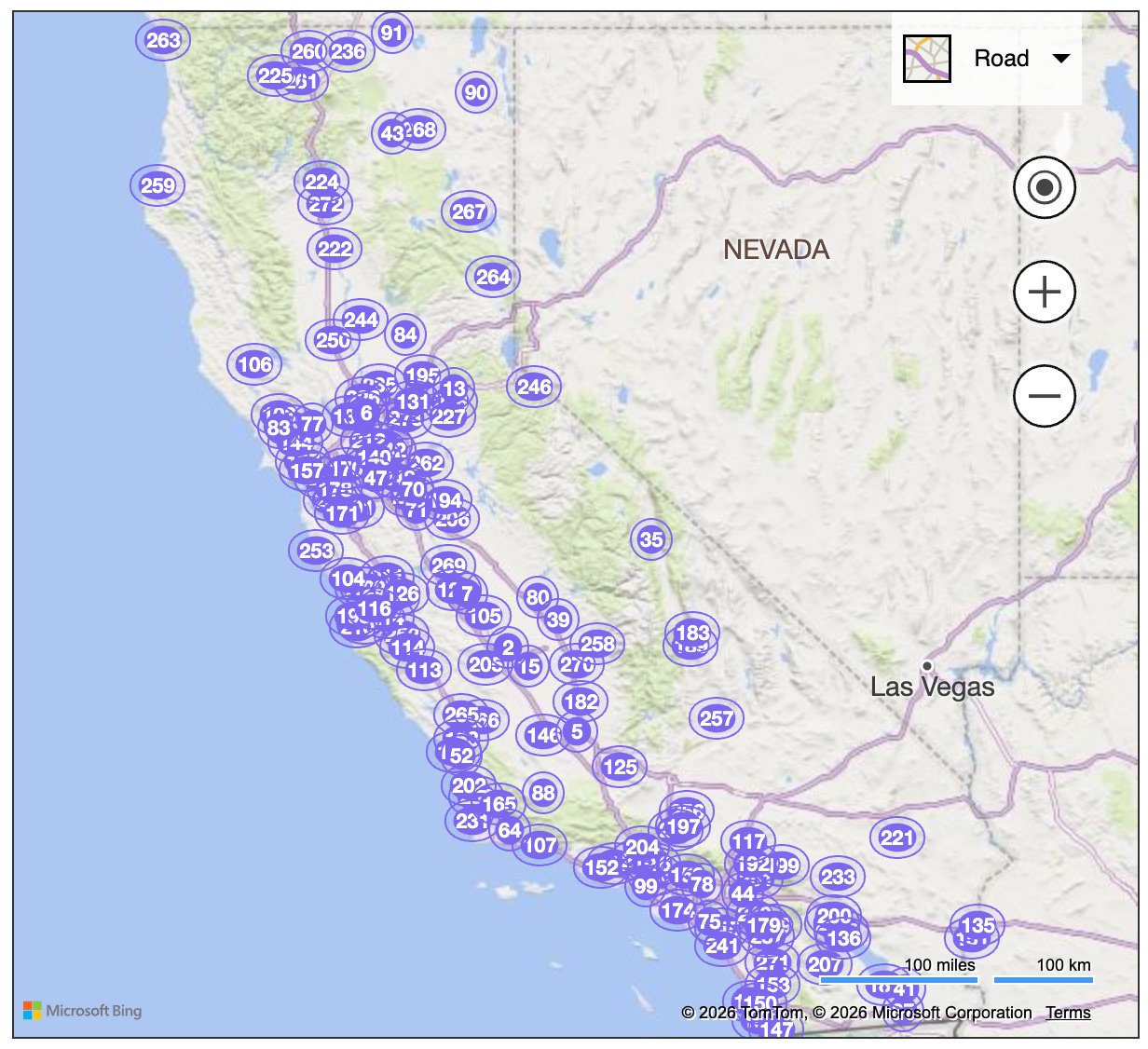
One of the largest determinants of an almond orchard’s lifetime water use is where it was planted. California’s almond geography is based on land availability, water-rights inheritance, and federal infrastructure. Soil conditions and water infrastructure affect water-use efficiency for almonds.
Picking the right location to grow and cultivate an almond orchard is an important decision, and it cannot be overturned for 25 years, unless one decides to discontinue the orchard before its useful life is over.
Picking the right location does not directly improve the water-use efficiency of almonds, but fallowing land unsuitable for growing almonds improves overall water-use efficiency at the aggregate level.
For example, the east side San Joaquin Valley orchards used 3.0 to 3.5 acre-feet per acre of water, with yields of 2800-3200 lbs per acre on mature, well-managed orchards, implying a water use of 350 to 400 gallons per pound of almonds. The west side of San Joaquin Valley orchards typically use 3.5 to 4.5 acre-feet per acre, with yields of 1800 to 2400 lbs per acre and an implied water use of 480 to 680 gallons per pound of almonds.
The per-pound water-use efficiency gap between these two categories of orchards is roughly 40–70%. The gap is due to factors such as water reliability stemming from senior surface water rights and stable groundwater basins, and soil quality, with the east side ground dominated by alluvial soils, whereas the west side soil has marine sediments with high salt concentrations.
The combination of sediments and poor drainage creates a salinity feedback loop, which accumulates salt in the root zone. This suppresses tree health and yield. The East side also benefits from lower summer temperatures and higher humidity, which reduces the evapotranspiration demand by 5-10%. Many farmers have fallowed acres on the Western side and moved them to the eastern side.
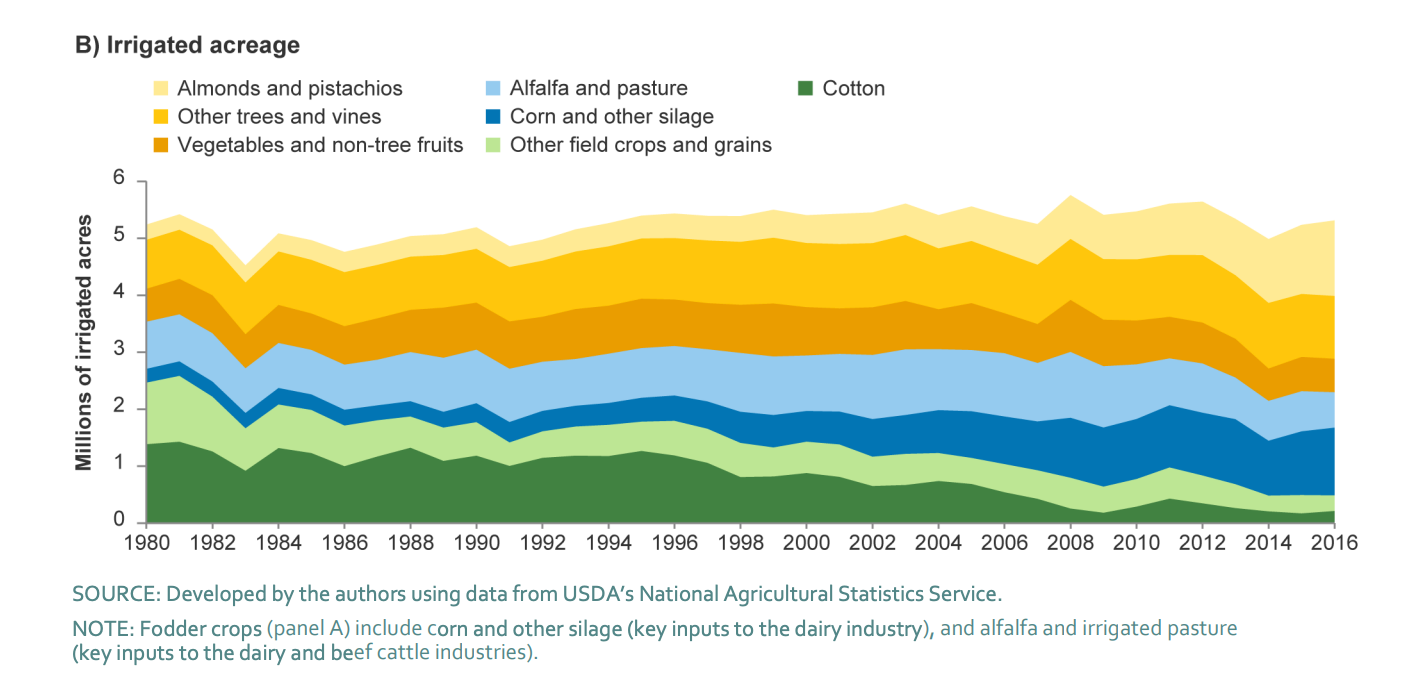
Many growers have stopped planting water-intensive crops that are not high-value on a per-acre basis. For example, the amount of cotton acreage5 has dropped significantly in California. This does not reduce the amount of water needed to grow almonds, but it reduces overall agricultural water consumption.
Water allocations
The Sustainable Groundwater Management Act (SGMA) is California’s plan to help communities manage their groundwater for the long term.
SGMA was enacted to halt the unsustainable use of groundwater and bring groundwater basins into balanced levels of pumping and recharge. Overuse and excessive groundwater pumping can overdraft aquifers, emptying them faster than natural systems can recharge them, leading to: lowering of groundwater levels, permanent loss of storage in aquifers, land surface sinking (subsidence), degradation of water quality, seawater mixing with fresh groundwater in coastal areas (seawater intrusion), and diminished surface water supplies where surface water and groundwater are interconnected.
The Sustainable Groundwater Management Act (SGMA) gave local groundwater sustainability agencies 26 years (until 2040, with a 2042 deadline for some basins) to bring critically overdrafted basins into balance. The first major implementation milestone was 2020, when local Groundwater Sustainability Agencies (GSAs) were required to file groundwater sustainability plans for the most overdrafted basins.
SGMA requires limiting groundwater extraction, which is forcing farmers to fallow land, reducing farm productivity, lowering land values, and causing financial distress. Estimates suggest significant job losses and economic decline in agricultural communities.
For example, during the 2021–2022 drought, surface water spot prices in the San Joaquin Valley exceeded $2,000 per acre-foot. Mature almonds use 3.5 to 4.5 acre-feet per acre per year, resulting in water costs of $7,000 to $9,000 per acre. It can exceed the total cost of all other production costs.
Nasdaq launched a California water futures contract in 2020. Districts have institutionalized fallowing-for-water programs in which growers with senior rights and flexible (annual) crops sell their allocation rather than plant. Farmers cannot fallow without killing the orchard, so they are price-takers. The SGMA restrictions are effectively shifting almond acreage to areas with lower groundwater dependence.
Geography, Infrastructure, and Policy story for the future
The one-third efficiency improvement in water use over the last 30 years has mostly come through changes in irrigation methods and evapotranspiration-based irrigation scheduling, with another layer of precision irrigation on top.
Since 1982, California has supported these efforts by creating a large weather station network, mentioned earlier as CIMIS, in partnership with the University of California at Davis. The precision irrigation layer has the potential to add a few more percentage points of improvement, but it does operate within the existing set of conditions. The combination of updated irrigation methods and new technologies, supported by infrastructure, has significantly boosted water efficiency, but the benefits of the technology curve might be approaching an asymptote.
The next curve will have to be a geography and policy story, with the removal of acres from marginal land, and effective management of water resources through SGMA.
Sources: Mount et al., Managing Drought in a Changing Climate (PPIC, 2019); Ullrich et al., “California’s Drought of the Future: A Midcentury Recreation of the Exceptional Conditions of 2012–2017” (Earth’s Future, 2018); Swain et al., “Increasing Precipitation Volatility in Twenty-first-century California.” (Nature Climate Change, 2018).
Source: https://www.ppic.org/wp-content/uploads/water-and-the-future-of-the-san-joaquin-valley-february-2019.pdf
This was a great level of detail, particularly on a topic that sometimes receives a lot of commentary without thoughtful analysis behind it. Then again, welcome to agribusiness.